One more thing I would like to talk about is the way in which we will be conducting our Movement in the future. As I mentioned earlier, our movement must be one that “grows with nature.” In other words, there is a need to: 1. Minimize greenhouse gas emissions as much as possible, and 2. Disseminate the teaching that man is a child of God on a large scale, deepening the sense of oneness between man and nature. In order to do this, we must try to avoid air and auto long-distance travel, assembling large numbers of people in a large venue, and wasting energy and resources. It becomes important to put our energy into seeking the Truth and propagating activities that we practice here in our daily lives. That is, we must make the small group gatherings of Readers’ Meetings, etc. that are at the frontline of our movement important bases of propagation. It is from that perspective that we have included an item in the Movement Policy for this year that describes “a high quality organizational movement.”
It is difficult for us to tell from Tokyo or the Main Temple what is happening in the other areas. We therefore need the ideas of those in the frontline who are familiar with what is happening locally. Our movement must also be an effective one that reflects and contributes to the needs of the area. It cannot be one set form, but must be diverse. On the other hand, we must not forget the core of the Seicho-No-Ie faith. We have been taught that Seicho-No-Ie refers to the “Grand Universe,” so while it must be diverse, at the same time our goal is a bright and cheerful movement that embodies God’s will. The development and expansion of the sundial way of life is the development and expansion of the will of God. So it is my hope that you will understand that our “Zero Carbon” movement is a variation of the spirit of the sundial way of life and is a creative, original movement closely related to your local communities, and that you will go forward to display your self-reliance brightly and cheerfully and unfold our movement.
If you look at nature, which is a reflection of the True-Image World, you will find that it is filled with an infinite number of ideas. Let us praise them, implement them in our lives and in our movement, and develop and expand our activities based on the divine will of God. This concludes my talk on this anniversary day that is overflowing with the blessings of nature. Thank you very much for listening.
Monday, November 26, 2007


Sunday, November 25, 2007
Fall Festival Address (3)
I would like to use a portion of this book and talk to you about how wonderful the sundial way of life is. It begins on page 101, with the chapter entitled, “Advanced Movement to Increase Happiness.” This is the talk I gave at the Spring Festival two years ago, but since I believe there are many here that did not attend that event, I would like to reintroduce the content of that lecture here:
Advanced Movement to Increase Happiness
I believe there will be many people here who will, when they hear “Sundial Diary” or “Laughing Practice,” or “Sundial Way of Life,” say that they’ve known about that for a long time. However, I learned recently that what is written in this Inaugural Issue (of the Seicho-No-Ie Magazine) is not in the least bit old. I have here a copy of the February 28, 2005 issue of Time magazine. It’s the most recent issue that just hit the stands the other day, and it includes a Special Feature. The cover has the title, “The Science of Happiness” on it, but if we were to translate this into Japanese, it would be something that many of us have heard before.
In this issue, there is a 17-page article on the results of a study of a new kind of psychology, different from what has existed until now. I cannot introduce all of this information at this time, but if I were to summarize parts of it, it says that the goal of psychologists used to be to bring patients “to zero,” if we were to think of the condition of our minds as a number scale, with the worst condition (i.e. suicidal) being a “minus five.” In other words, the goal was to treat and bring the patient from a neurotic ailing state to a neutral normal one. It seems, however, that the trend amongst psychologists today is “positive psychology.” Positive psychology has a very proactive and positive goal and is studying ways to bring someone in a normal state of mind, “0,” to a “plus 3,” or “plus 5.”
There are different things written in the article, but, to share a portion of it with you, there are various study results regarding what makes us happy. Ordinarily, we might think the answer would be “having money” or “additional income,” but researchers found that there was no data supporting this. “Additional income” did little to raise people’s sense of satisfaction or happiness, nor did “a good education” or “a high IQ.” Then is “youth” the source of happiness? No, that isn’t it either. On the contrary, it seems that older people are more consistently satisfied with their lives than the young. How about not having to work frantically and being able to sit leisurely in front of a TV not thinking about anything? That doesn’t seem to be it either because findings state that when watching TV, those who watch it for more than three hours a day feel less happy than those who watch it for fewer hours a day. The studies show that there is “less sense of happiness.”
What does lift the spirit and make one feel happier is “religious faith.” So, too, do “warm, loving relationships with friends and family.” Moreover, studies have found that people feel happy when they have a job that allows a certain degree of freedom, and not having to do the same thing in the same way everyday.
Additionally, what do we need to do in order to implement the findings of this study in our daily lives? There are different methods described regarding that, too. This is something very interesting—It mentions a “gratitude journal” or “gratitude exercise” is important. This means that “being grateful leads to an increased sense of happiness”—this is something that we’ve heard somewhere before, isn’t it? It is the exact same way of thinking that we have been advocating and practicing since long ago. Looking for and making note of the good, positive points in people is the starting point in a life of increased happiness. And, to expand happiness, this article describes “performing acts of altruism.” When it comes down to this, it’s difficult to determine whether we’re talking about psychology or religion, but we have come to find that those things are very effective in realizing a life of happiness.
One of the psychologists conducting these kinds of studies is Martin Seligman. According to Dr. Seligman, one way towards an increased sense of happiness is a “gratitude visit.” These are a little different than the gratitude visits that are made when we are promoting attendance at Grand Lectures. It works like this: You think of a person in your life who has been kind to you but whom you've never properly thanked—for example a supervisor, grandfather, your father, a relative or a friend—and write a ''gratitude letter'' to that person. You explain in detail how the words of that person at a certain time were very helpful and how you are now living a very happy life thanks to his advice or encouragement. Then you visit that person and read that letter in front of him. According to Dr. Seligman, when you pay a “gratitude visit” you can feel a sense of happiness throughout the following month…
In this way, the “sundial way of life” is a leading way of thinking and living life today.
Advanced Movement to Increase Happiness
I believe there will be many people here who will, when they hear “Sundial Diary” or “Laughing Practice,” or “Sundial Way of Life,” say that they’ve known about that for a long time. However, I learned recently that what is written in this Inaugural Issue (of the Seicho-No-Ie Magazine) is not in the least bit old. I have here a copy of the February 28, 2005 issue of Time magazine. It’s the most recent issue that just hit the stands the other day, and it includes a Special Feature. The cover has the title, “The Science of Happiness” on it, but if we were to translate this into Japanese, it would be something that many of us have heard before.
In this issue, there is a 17-page article on the results of a study of a new kind of psychology, different from what has existed until now. I cannot introduce all of this information at this time, but if I were to summarize parts of it, it says that the goal of psychologists used to be to bring patients “to zero,” if we were to think of the condition of our minds as a number scale, with the worst condition (i.e. suicidal) being a “minus five.” In other words, the goal was to treat and bring the patient from a neurotic ailing state to a neutral normal one. It seems, however, that the trend amongst psychologists today is “positive psychology.” Positive psychology has a very proactive and positive goal and is studying ways to bring someone in a normal state of mind, “0,” to a “plus 3,” or “plus 5.”
There are different things written in the article, but, to share a portion of it with you, there are various study results regarding what makes us happy. Ordinarily, we might think the answer would be “having money” or “additional income,” but researchers found that there was no data supporting this. “Additional income” did little to raise people’s sense of satisfaction or happiness, nor did “a good education” or “a high IQ.” Then is “youth” the source of happiness? No, that isn’t it either. On the contrary, it seems that older people are more consistently satisfied with their lives than the young. How about not having to work frantically and being able to sit leisurely in front of a TV not thinking about anything? That doesn’t seem to be it either because findings state that when watching TV, those who watch it for more than three hours a day feel less happy than those who watch it for fewer hours a day. The studies show that there is “less sense of happiness.”
What does lift the spirit and make one feel happier is “religious faith.” So, too, do “warm, loving relationships with friends and family.” Moreover, studies have found that people feel happy when they have a job that allows a certain degree of freedom, and not having to do the same thing in the same way everyday.
Additionally, what do we need to do in order to implement the findings of this study in our daily lives? There are different methods described regarding that, too. This is something very interesting—It mentions a “gratitude journal” or “gratitude exercise” is important. This means that “being grateful leads to an increased sense of happiness”—this is something that we’ve heard somewhere before, isn’t it? It is the exact same way of thinking that we have been advocating and practicing since long ago. Looking for and making note of the good, positive points in people is the starting point in a life of increased happiness. And, to expand happiness, this article describes “performing acts of altruism.” When it comes down to this, it’s difficult to determine whether we’re talking about psychology or religion, but we have come to find that those things are very effective in realizing a life of happiness.
One of the psychologists conducting these kinds of studies is Martin Seligman. According to Dr. Seligman, one way towards an increased sense of happiness is a “gratitude visit.” These are a little different than the gratitude visits that are made when we are promoting attendance at Grand Lectures. It works like this: You think of a person in your life who has been kind to you but whom you've never properly thanked—for example a supervisor, grandfather, your father, a relative or a friend—and write a ''gratitude letter'' to that person. You explain in detail how the words of that person at a certain time were very helpful and how you are now living a very happy life thanks to his advice or encouragement. Then you visit that person and read that letter in front of him. According to Dr. Seligman, when you pay a “gratitude visit” you can feel a sense of happiness throughout the following month…
In this way, the “sundial way of life” is a leading way of thinking and living life today.
Saturday, November 24, 2007
Fall Festival Address (2)
This year, we in the Seicho-No-Ie movement have begun “A Movement That Grows With Nature—Phase 1 Five-Year Plan.” “Phase One” means that we are also thinking about a “Phase Two” to follow, and that within the next ten years, we will have realized a “Movement That Grows With Nature.” This is not simply an environmental movement. What I would like to ask you to keep in mind is that ours is a Movement to manifest the True-Image world here on this earth, based upon the Truth that “the God-created True-Image world is only goodness and Grand Harmony.”
“Growing with nature” means that we cannot carry on a movement that disseminates the Truth that “man is a child of God” and destroy nature while we are doing so. We must conduct our movement within the regenerative limitations of nature, and nurture nature as well as the awareness of all people. That is why our goal is not only to live together with nature but also to grow and evolve with it. This movement is not one that goes against or defies anything, but is one that stands in the forefront of and leads society and is based on the biological truth that “man is a part of nature.” Therefore, it is the natural responsibility of people worldwide to protect against global warming. If this lifestyle and mindset is not actually practiced in our daily life, there will be no future for humankind.
I believe that at the root of the environmental problems that confront us today lies anthropocentrism, particularly as it applies to human desires and needs. Man is a child of God, so we need to revere and respect one another. That does not mean, however, to value human desires or needs. Instead we must value the “God-nature” that lies within, beyond those desires. Unfortunately, through advertising and the media’s emphasis not on what we have been given but what we lack, we try to raise demands to stimulate the market. We purposely shorten products’ life-cycle and models of products frequently. If we continue to do this, there will never be enough for our planet. In the East, there is an adage that emphasizes being content with what you have. This thinking, however, was criticized as trying to justify the feudal system, so was considered for a long while to be “old-fashioned.” However, now in the 21st century, feudal systems do not exist anywhere within the developed countries. Liberalism/democracy superseded that, but, unfortunately, it would seem that we are instead heading towards a system that emphasizes human desires.
In the 21st Century in which global warming is progressing, there is a need for a new movement with religious fervor that emphasizes being content with what you have, which comes, not from the top-down, but swells up from the grassroots. The Kenyan environmentalist, Wangari Maathai, advocated introducing the traditional Japanese concept of mottainai (Editor’s Note: Roughly translated, this word means “it is so wasteful that things are not fully used.” Maathai equates it to the English phrase “Reduce, Reuse, Recycle.”). I think this is a wonderful idea, but I’d like to tell you about the more original way of thinking that Seicho-No-Ie has had, and that is the “sundial way of life.”
The sundial way of life looks at all the bright and positive aspects of life. Unlike the system that holds human desires in highest regard, this way of thinking looks, not at what is lacking, but recognizes and gives thanks for all that we have been given, what we have been blessed with, and the fact that we are alive. This is something that is shared with the spirit of mottainai, and at the same time, is based on the faith in a world of only goodness and is a way to practice concretely drawing out the True Image into the phenomenal world. I wrote about this in detail in the book Hidokei Shugi towa Nanika? (“What is the Sundial Way of Life?”” Seicho-No-Ie Publications) which was published to commemorate this Fall Festival. I would like to ask that you all read this book and better understand that the sundial way of life is a new movement to manifest the True-Image.
“Growing with nature” means that we cannot carry on a movement that disseminates the Truth that “man is a child of God” and destroy nature while we are doing so. We must conduct our movement within the regenerative limitations of nature, and nurture nature as well as the awareness of all people. That is why our goal is not only to live together with nature but also to grow and evolve with it. This movement is not one that goes against or defies anything, but is one that stands in the forefront of and leads society and is based on the biological truth that “man is a part of nature.” Therefore, it is the natural responsibility of people worldwide to protect against global warming. If this lifestyle and mindset is not actually practiced in our daily life, there will be no future for humankind.
I believe that at the root of the environmental problems that confront us today lies anthropocentrism, particularly as it applies to human desires and needs. Man is a child of God, so we need to revere and respect one another. That does not mean, however, to value human desires or needs. Instead we must value the “God-nature” that lies within, beyond those desires. Unfortunately, through advertising and the media’s emphasis not on what we have been given but what we lack, we try to raise demands to stimulate the market. We purposely shorten products’ life-cycle and models of products frequently. If we continue to do this, there will never be enough for our planet. In the East, there is an adage that emphasizes being content with what you have. This thinking, however, was criticized as trying to justify the feudal system, so was considered for a long while to be “old-fashioned.” However, now in the 21st century, feudal systems do not exist anywhere within the developed countries. Liberalism/democracy superseded that, but, unfortunately, it would seem that we are instead heading towards a system that emphasizes human desires.
In the 21st Century in which global warming is progressing, there is a need for a new movement with religious fervor that emphasizes being content with what you have, which comes, not from the top-down, but swells up from the grassroots. The Kenyan environmentalist, Wangari Maathai, advocated introducing the traditional Japanese concept of mottainai (Editor’s Note: Roughly translated, this word means “it is so wasteful that things are not fully used.” Maathai equates it to the English phrase “Reduce, Reuse, Recycle.”). I think this is a wonderful idea, but I’d like to tell you about the more original way of thinking that Seicho-No-Ie has had, and that is the “sundial way of life.”
The sundial way of life looks at all the bright and positive aspects of life. Unlike the system that holds human desires in highest regard, this way of thinking looks, not at what is lacking, but recognizes and gives thanks for all that we have been given, what we have been blessed with, and the fact that we are alive. This is something that is shared with the spirit of mottainai, and at the same time, is based on the faith in a world of only goodness and is a way to practice concretely drawing out the True Image into the phenomenal world. I wrote about this in detail in the book Hidokei Shugi towa Nanika? (“What is the Sundial Way of Life?”” Seicho-No-Ie Publications) which was published to commemorate this Fall Festival. I would like to ask that you all read this book and better understand that the sundial way of life is a new movement to manifest the True-Image.
Friday, November 23, 2007
Fall Festival Address (1)
Here I post the translation of a summary of my address delivered at the Seicho-No-Ie Fall Festival held at the Main Temple in Nagasaki, Japan, on November 22, 2007. It consists of four parts.
- MT
The Sundial Way of Life Is A Movement to Manifest the True Image
- MT
The Sundial Way of Life Is A Movement to Manifest the True Image
(The following is a summary of the Congratulatory Address I gave at the Fall Festival held at the Seicho-No-Ie Main Temple in Nagasaki, Japan on November 22, 2007 as posted on my Japanese blog the same day.)
Ladies and Gentlemen, I would like to extend my heartfelt thanks to all of you for attending the Seicho-No-Ie Fall Festival and Commemorative Ceremony today. It’s suddenly become very cold in Japan since the middle of this month, and the nights have grown especially cold. In Tokyo, many of us have started to turn on our heaters from about a week ago. The low in Tokyo on the 18th was 6.7° centigrade (approximately 44° Fahrenheit), 2.4° colder than average, but the high was 19.4° centigrade (66.9° Fahrenheit). We arrived here in the afternoon of the 20th, and it seems that the temperature in the morning dropped to 3° centigrade (37.4° Fahrenheit). It’s been cold here since then as well.
The fall foliage is beautiful when it gets cold, though. I hope that you have been able to take in the brilliant autumn reds and yellows in and around Kinryuko pond. Here at the Seicho-No-Ie Main Temple, we can experience nature’s abundant blessings of both the mountains and the sea. Not only do the clear skies and fall foliage comfort us visually and emotionally (as those who have participated in Spiritual Training Seminars at the Main Temple know), but nature satisfies our palates as well. The oranges here are delicious now, and I understand we can also pick chestnuts. The persimmons are plentiful and ripe, and, when we watch the birds that come to eat them, our minds and hearts are also fulfilled and content. I believe this is by nature the true relationship between nature and people.
As you are all aware, global warming is progressing rapidly in the world today, primarily because of what humans have been doing, and this has conversely begun to threaten our lives. Recently we have had disasters that caused widespread damage, such as the powerful cyclone that struck Bangladesh resulting in thousands of deaths. Situations in which nature is destroyed and becomes poorer while humans prosper have existed since long ago. We know this well from actual things we’ve experienced since the days of pollution to current modern-day city life. The problems of today, however, stretch beyond that. When nature is destroyed because of what people do, nature is reduced and conditions become grave and serious for all people. That means that our own lives are slowly destroyed as a result and become poorer. Humankind in the 21st century has become aware of this, and realizes that something must be done, but they don’t know where or how to begin. This is what’s happening now.
Ladies and Gentlemen, I would like to extend my heartfelt thanks to all of you for attending the Seicho-No-Ie Fall Festival and Commemorative Ceremony today. It’s suddenly become very cold in Japan since the middle of this month, and the nights have grown especially cold. In Tokyo, many of us have started to turn on our heaters from about a week ago. The low in Tokyo on the 18th was 6.7° centigrade (approximately 44° Fahrenheit), 2.4° colder than average, but the high was 19.4° centigrade (66.9° Fahrenheit). We arrived here in the afternoon of the 20th, and it seems that the temperature in the morning dropped to 3° centigrade (37.4° Fahrenheit). It’s been cold here since then as well.
The fall foliage is beautiful when it gets cold, though. I hope that you have been able to take in the brilliant autumn reds and yellows in and around Kinryuko pond. Here at the Seicho-No-Ie Main Temple, we can experience nature’s abundant blessings of both the mountains and the sea. Not only do the clear skies and fall foliage comfort us visually and emotionally (as those who have participated in Spiritual Training Seminars at the Main Temple know), but nature satisfies our palates as well. The oranges here are delicious now, and I understand we can also pick chestnuts. The persimmons are plentiful and ripe, and, when we watch the birds that come to eat them, our minds and hearts are also fulfilled and content. I believe this is by nature the true relationship between nature and people.
As you are all aware, global warming is progressing rapidly in the world today, primarily because of what humans have been doing, and this has conversely begun to threaten our lives. Recently we have had disasters that caused widespread damage, such as the powerful cyclone that struck Bangladesh resulting in thousands of deaths. Situations in which nature is destroyed and becomes poorer while humans prosper have existed since long ago. We know this well from actual things we’ve experienced since the days of pollution to current modern-day city life. The problems of today, however, stretch beyond that. When nature is destroyed because of what people do, nature is reduced and conditions become grave and serious for all people. That means that our own lives are slowly destroyed as a result and become poorer. Humankind in the 21st century has become aware of this, and realizes that something must be done, but they don’t know where or how to begin. This is what’s happening now.
On November 17, 2007, the United Nations’ Intergovernmental Panel on Climate Change (IPCC) finalized and published its Synthesis Report, the fourth and final in a series. This report indicates the findings of meteorologists worldwide who agreed that every possible countermeasure against global warming must be implemented immediately in order to keep the growth of further damage and disasters in check. This does not refer to only one specific measure, but to execute any and all countermeasures that we can think of, including emissions trading and carbon tax. It also includes all of the following possible measures: Nuclear power generation, use of renewable energy, underground carbon sequestration, hybrid cars and increased usage of biofuels, growth of energy conservation technology, etc. That is how urgent and critical the situation is. (to be continued)
Sunday, September 16, 2007
Little Blue and Little Green
Since many people have reqested to view the cartoon slide "Little Blue and Little Green" which I presented at the Seicho-No-Ie International Special Conference for World Peace this August, I decided to upload an edited version of the slide onto YouTube. I am afraid that the quality of the pictures and sounds is not very good but hope you would get the message.
- MT
- MT
Monday, August 13, 2007
Recollection of New York City
Here I have compiled and presented two short movies representing my recollection of NYC this time. I didn't go uptown nor to Central Park but, instead, stayed in the downtown area including the Village and the port. Hope you enjoy them.
- MT
- MT
Friday, August 10, 2007
Heading for the Conference
This video describes what my impressions are before the Special Conference started. I appreciated for the tranquility of the center and the enthusiasm of the participants very much. I'm also grateful for the kindness and generosity of those who participated in the conference, especially Dr. Khaled Abou Fadl.This video describes what my impressions are before the Special Conference started.
- MT
- MT
Thursday, August 09, 2007
Arriving in New York City
I recently went to New York to attend the Seicho-No-Ie Special Conference for World Peace, which was held on August 4-5 in a suburb of New York City.
The following video is my impression of the city.
- MT
The following video is my impression of the city.
- MT
Tuesday, October 10, 2006
Before Praying
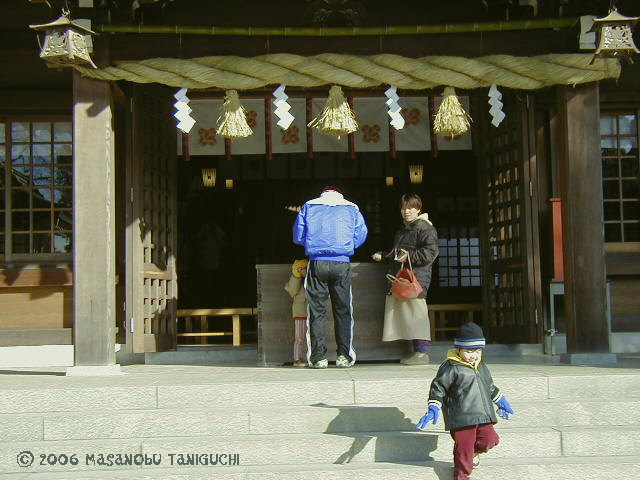
A little boy is wandering away from the shrine before his parents and sister have had a chance to finish praying. My mother tells me that I was a restless kid, too. I might have had a short attention span, but it also might be that I, like the little boy in the photo, was paying attention to something other than what he was expected to. Just as this watchful mother pays extra attention to him, my mother may have made extra efforts in raising me, something for which I am very grateful.
- MT
Sunday, October 01, 2006
Road from a Shrine (2)

A young couple is walking out of the shrine, probably after praying for their future and happiness. I am reminded of the early years of my marriage or even before that, when I envisioned a bright but somehow uncertain future with my (prospective) wife. Looking back from after 25+ years, I now feel certain and am confident that the sharing of our lives has produced a rich, fruitful experience that we could not have had without marriage. I hope this couple will walk together in that direction.
- MT
Friday, September 15, 2006
Road from a Shrine
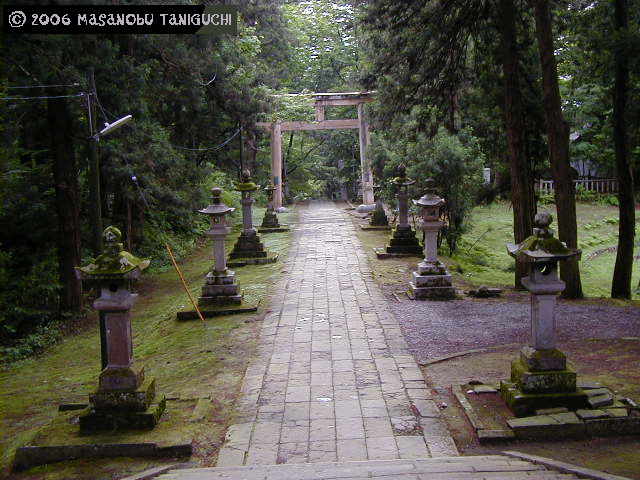
I took this photo immediately after having paid homage at a shrine. Feeling at peacel after praying, the same path I climbed toward the deity a few minutes before looked different. I felt relieved and relaxed and found the scene very congenial to my state of mind. The symmetry of the scene perhaps held the scret of this state of mind.
- MT
Sunday, September 10, 2006
Road to a Shrine

The path leading to a shrine or temple is often made to imply a "difficult path." There may be a long flight of steps or a series of gates to pass, or both. Pilgrims are willing to surmount these obstacles in order to get a sense of being spiritually uplifted. This is sometimes similar to endurance sports such as mountain climbing and long-distance running. It may be that the ultimate objective of the sports and that of the pilgrimage are the same.
- MT
Friday, September 01, 2006
Tree-Lined Road

We love to plant trees along the roads. This is not done necessarily to suggest a destination for pedestrians nor to provide an opportunity for unexpected encounters. I look at it as a way to enjoy distractions. Life can be described in terms of destinations or a series of choices, but it also has plenty of distractions. The gingko leaves are beginning to turn the vibrant yellow of the fall. By this time, the female trees are full of fragrant fruit and sprinkle them on the road. Some people hate the smell and avoid going near the fruit, but other don't hesitate to pick them up from off the road to serve for dinner. In this sense, life consists of many distractions, and we love them.
- MT
Thursday, August 31, 2006
Stepping Stones
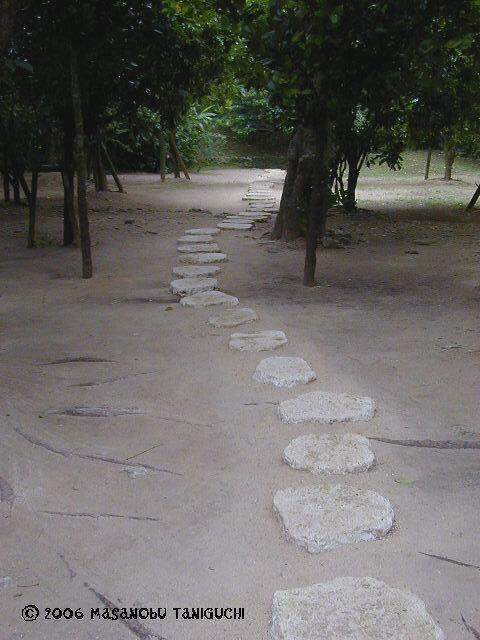
Unlike railway tracks which suggest a predetermined direction, a path of stepping stones may give us the sense of it being a series of choices. It nevertheless leads to a predetermined place as well. In this sense, it may be more like real life, in which we make many decisions, but may sometimes feel we cannot help but lead ourselves to an inevitable place.
- MT
Wednesday, August 30, 2006
Railways

Railway tracks are laid to transport people and things to far-away places, smoothly and quickly. When seen from above, they make clear silver lines that sometimes stimulate our imagination. These lines in the photo stir a sense of destiny in my mind. Two sets of lines merge into one in the distance. It can be likened to marriage or friendship. Another set of lines approach from the left. This may be a sibling or someone from our past. A woman and a dog crossing the tracks can be another relationship we come across in our journey throughout our destiny.
- MT
Wednesday, August 23, 2006
Ticket Booths
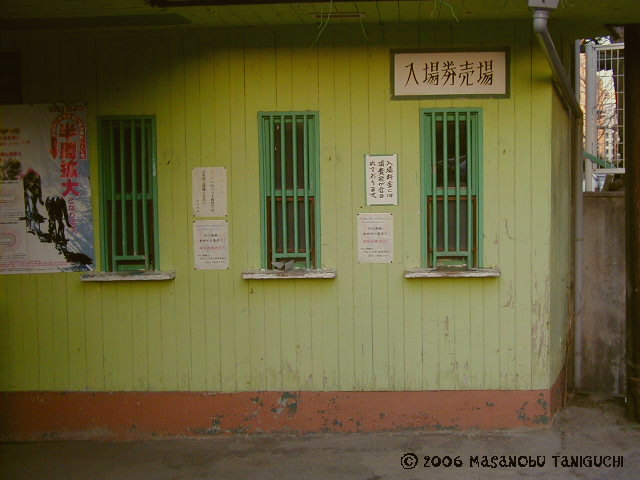
I am not particularly fond of bicycle racing but found the color combination of these booths impressive. The Japanese usually do not paint buildings in bright colors such as yellow, red and green. This building is therefore an exception. And, when I look at the scratches and cracks on the wall, I can almost see those who win and lose at the race and hear them screaming and grumbling.
- MT
Tuesday, August 22, 2006
Osaka Night

Osaka is the third largest city in Japan in terms of population. Being a Tokyoite, I am not very familar with the city even though I have visited it for short stays several times in the past. This photo was taken from a high-rise hotel and probably reflects one feature of the city: highways and buildings spread to the furthermost edge. Night effectively conceals the chaotic intricacy of the cityscape with the lights giving it a sense of composition.
- MT
Monday, August 21, 2006
A Remote Mountain (3)
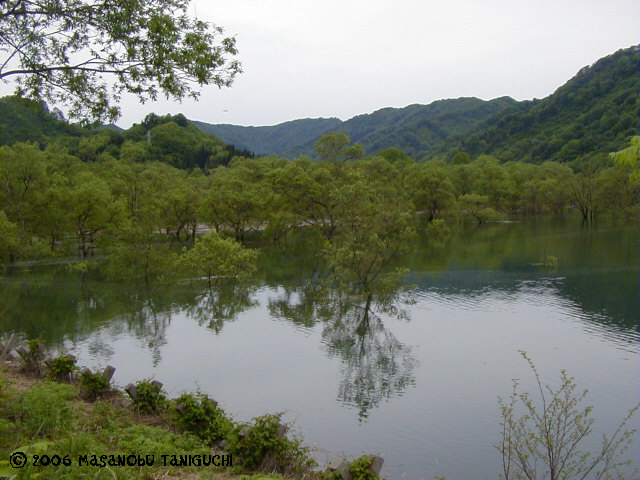
When I went to the mountain in the Spring, I was impressed with the serenity of Lake Yakuwa, where trees, half-submerged in the waters, survive and are even thriving, 45 years after the construction of Yakuwa Dam. In the novel I wrote, the newspaper reporter scuba-dives in the lake to find a way to get to the old deserted village about which he heard from a retiring police officer.
- MT
Sunday, August 20, 2006
A Remote Mountain (2)

The idea of the story was inspired by the movie "Nell"(1994) in which a small-town Southern doctor discovers a woman who's been raised completely apart from civilization. I changed the situation a bit by moving the locale to a Japanese moutain in which a newspaper reporter discovers a 15 year-old girl. Her parents became isolated from civilization when they refused to move from their mountain home when water from a dam constructed nearby flooded the area around their house.
I'd rather not reveal the whole story. This photo shows one of a few dams located near Tsuruoka, where the main part of the story develops.
- MT
Friday, August 18, 2006
Remote Mountains
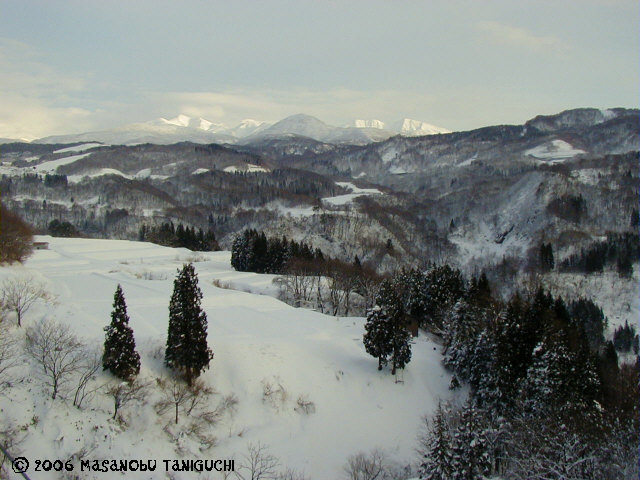
The photo was taken a couple of years ago when I went to Tsuruoka, Yamagata Prefecture, in order to begin writing a novel I entitled "Hikyo" (A Remote Mountain). The story is about a girl living alone in a remote mountain region, completely secluded from modern civilization. Of course, no such place exists in present-day Japan. However, this scene fit my idea perfectly. I recently started a painting based on this photo for the forthcoming book.
- MT
Subscribe to:
Posts (Atom)

