Sunday, July 16, 2006

Flowers

I am on a plane flying from Asahikawa, Hokkaido, back to Tokyo. My wife and I attended the Seicho-No-Ie Public Lecture meeting held in Asahikawa. Although it was too warm and humid in Tokyo, the people in Hokkaido, the northernmost island of Japan, are now enjoying the best season in the year. It is dry and cool with many different blowers blooming.. The leaves of the trees are bright in the sunshine, and the cherry trees are heavy with their red delicious fruit.

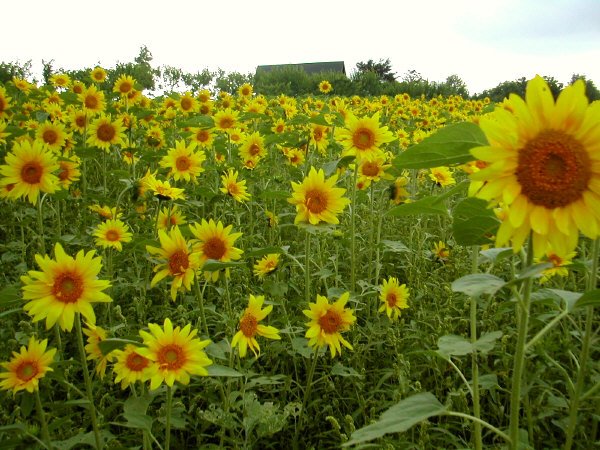
After the lecture meeting, we went to a flower park in Bibai, located on the outskirts of Asahikawa City. the park was literally covered with flowers of so many different colors--sunflowers, lavender, petunias, begonias, digitalis, lupines, marigolds, lilies, and California poppies. We walked slowly by the blanket of flowers, praising their beauty as we took photos here and there. There were many other people doing the same. I realized that they were truly enjoying the sights and we were, too.

As I wrote in my July 12th entry, we are "visual animals." All the colorful stimuli entering my eyes made me feel truly relaxed and happy. It was especially revealing that this took place even after the six hours of work at the meeting. The lecture meeting started at 10:00 am and lasted until 3:00 pm with an hour taken for lunch. I gave two one-hour lectures for this meeting and conducted a short meditation session as well. Afterwards, my wife and I attended a one-hour meeting with the local SNI leaders. by the time the meeting with these leaders was over, I felt exhausted. But I recharged myself with a glass of cold water then proceeded to the gate of the lecture hall where dozens of people were waiting to shake hands with us. I would say that flowers are man's dearest friends, just as dogs are our oldest. They lift us up and make us feel gentle and loving with their colors, shapes and fragrance.

- MT

Saturday, July 15, 2006

If Mice Have Empathy...

Science magzine recently reported that mice may have empathy toward other mice(Science vol. 312, 30 June 2006). This shocked me because I just got the renewed impression that humans have little empahy toward other animals, especially those raised for consumption. Empathy has often been thought to be a uniquely human attribute. It has been argued that in order to experience empathy we humans developed story-telling, operas, sports, novels, movies, and many other cultural events. When the German soccer captain butted an Italian player in front of TV cameras, many, if not most, felt empahy toward the former, thinking that he had been badly insulted, so badly that no one could blame him for ruining his last match as professional soccer player.

But if mice too have capacity for empathy, a whole different picture would emerge. A laboratory mouse may feel pain when seeing other mise being subject to unpleasant treatment. Since there is no reason to believe mice have more empathy than pigs, a pig, too, may feel intense fear seeing other pigs butchered. Then, what about a cow hearing other cows screaming in a slaughterhouse reeking with blood? I would therefore suggest that we should treat our fellow animals more "humanely." I'm not only talking about dogs and cats but also about cows and pigs.

- MT

Thursday, July 13, 2006

Macrobiotics

I am back home from our mountain villa, lying in bed, typing on the keyboard of my laptop. A soft breeze coming from the electric fan makes me relaxed. It has become cooler, but I was shocked by the heat in Tokyo about four hours ago when I came out of my car to have dinner with my daughter and wife. It was humid and around 30 degrees celsius, or 86 degrees Fahrenheit. We all agreed that we missed the cooler temperature and drier atmosphere at the villa.

During the dinner my 21-year-old daughter raised a question on Macrobiotics. Skimming throughthe two books on this subject which my wife bought during our stay in Ohizumi, my daughter seemed to be interested in this dietary lifestyle. She asked if my wife and I, already semi-vegetarians, were going to quit all meat including chicken. My wife answered, "No. At least not now, though we may be gradually reducing chicken meat."

Macrobiotics recommends that we base our diet primarily on foods native to the climate and environment in which we live. That is because our body is genetically adapted and, therefore, most fit to our environment. The basic idea is to eat food that is locally produced. Macrobiotics also asserts that our teeth represent the ideal proportion of foods in the human diet. That is, it recommends that we eat less meat and more grains and vegetables because most of our teeth are designed to crush or grind grains, beans, seeds, and other tough plant fibers and to cut vegetables. According to them, the ideal proportion of human foods is five parts grain and other tough fibrous foods, two parts vegetables, and one part animal food.

About a week ago my wife and I attended a Seicho-No-Ie Special Conference, where many problems in meat-eating were discussed. There are basically three areas of concern: 1) ethical and religious issues, 2) health issues, 3) environmental issues. My wife seemed so impressed with the seriousness of the problem in meat-eating that she wanted to pass some of the information she got there to our daughter.

- MT

Wednesday, July 12, 2006

Mowing the Lawn

It took some time for me to notice that my wife was up and working outside. I was in my futon bed trying to go back to sleep, thinking that I had not had enough sleep, when I heard the knocking-like sound near the front door of the villa. The sound, rather hollow and not repetitive, was not exactly like knocking. I assumed therefore that my wife was taking something out of the storage by the front door and made the sound when she shut the door of the storage room. I went back to sleep afterward.

I woke up from a short dream, noticing that she was sitting by the kitchen table. I asked her about the time and she told me that it was around seven-thirty. I decided to get up. She told me that she couldn't wait pulling out weeds and cutting the overgrown lawn until I got up. I asked her when she got up."Well, I think it was around five thirty," she said. I was impressed with her vitality.

After having breakfast I went out to see what my wife had done. It was a mess, not because she had done anything wrong but because she could not catch up with the wilderness nature had produced during the two months of our absence. I started to gather drawn-out weeds and cut grasses and, then, involved myself in mowing the lawn. It was only after my wife came out and told me what time it was that I, drenched with sweat and mud, decided that I should stop the work no matter how unsatisfactory it looked. Two hours passed like a half an hour.

It is sometimes said that humans are "visual animals." This is because we are preoccupied with the information obtained through our visual system. Visual arts, tourism, gymnastics, sports, racing, scuba diving, sky diving, space flight, and even eating cannot be fully enjoyed without seeing. Gardening may be one of those human endeavors born out of this preoccupation. No matter how strongly we are attracted by nature, we seldom give up modifying nature when nature looks truly natural.

- MT

Escape from Humidity

It has become humid and warm in Tokyo these days. The tropical storm that hit China and Korea recently has brought even more humidity and heat over Japan. It is this humidity that makes living in Tokyo unconfortable and even miserable in Summer. This is why I decided Today to go to our mountain villa with my wife.

It's been more than two months since we were there the last time. It was in May, and we still could see cherry blossoms in the mountains. There were even snowcaps on the mountain tops above 2,000 meters. I took several Spring shoots from Taranoki (Aralia elata) and enjoyed tempura using them.

This time our 22-year-old daughter decided to join us. Three of us had dinner together at an Italian restaurant near Meiji Park and left Tokyo for Ohizumi, Yamanashi prefecture, where our villa is located. We were all jubilant. My wife had just finished her one-hour lecture at a meeting, my daughter after her work, and I after submitting my manuscript for a monthly magazine. We all needed some good rest.

- MT

Tuesday, July 11, 2006

Can't Help Saying This

I've decided to enter this club of bloggers so that I could say something to my English audience. I wanted to say that my Japanese blog has been experiencing a problem for a while, probably about 3 days. I had difficulty in entering and registering blog entries, and the system administrators, whoever they are, were not responding at all. So, I decided to go "overseas" and complain. This may not sound like a good reason to blog. But I cannot help it.

Thank you for your taking the time to read this.

- MT

Wednesday, September 11, 2002

Cancellation of this Series

I believe there may have been some readers who've been concerned about the interruption or break between my journal entries. Due to many factors, I've decided to suspend this series for now. I'd like to thank all you readers for allowing me to ramble on about everything--from new scientific technology and issues dealing with the environment, personal miscellaneous writings, things that happened at home, eating habits, to puns--during this past year and a half. The feedback that I received from you was what helped me continue this for as long as I have. It was the biggest source of encouragement for me. The entries in this series became two books, Shokan Zakkan Part 1 and Shokan Zakkan Part 2, so it was by no means a waste.

It's not that the feedback from readers has stopped. The biggest reason for my deciding to suspend this section is that because I can no longer continue to provide both articles and drawings for the entries. And I've also come up with something else I'd like to do. Those who have their own website can, I'm sure, understand, but it takes a lot of time and energy to maintain a site. If one begrudges this, it soon becomes "old" and "covered with cobwebs"--a "haunted house" that no one will want to visit. So, before that happens, it's probably best to announce that "This house is closed."

I am going to suspend with the regular entries to this site, but, when I have something to say, I intend to write elsewhere in another section. Although I don't have too many occasions to draw any more, I will probably share new drawings with you on another page, too.

It's been a year since the terrorist attacks on the United States. It's wonderful that we were able to observe the "First Anniversary" of that event without a repetition of what happened then. However, without having confirmed or captured the person or persons responsible for this horrendous crime, President Bush has clearly defined his plans to attack a "new enemy" and is seeking people to endorse this. On the other hand, it also seems that the United States is refusing to deal seriously with global warming. War is the most direct way of destroying nature, and, at the same time, destroys the minds and physical bodies of all people involved as well. When we think of it in these terms, I would really like the leaders of all nations to assist and ensure that humankind does not go in this direction of "destruction."

Shouldn't we who believe in God try to believe even more completely and totally in Him? We cannot believe in a "God" who loves a particular group of people, and hates, curses, and murders others. That is simply trying to justify belief in a "deluded self" in the name of God. If God, omnipotent and omniscient, creates "enemies" and "evil", or allows for "enemies" and "evil", then there is no way that we humans, who are neither omnipotent nor omniscient, can win against the "enemy" or destroy "evil." In other words, there will be no peace on this earth with that kind of belief or religion. So, it's up to us--we must go beyond belief in that kind of prejudiced and biased God, and spread the belief that "God does not create evil" throughout the entire world.

- MT

Wednesday, August 21, 2002

A Blessed Classroom

In the "Voices" column of today's Asahi Shimbun newspaper, there was a letter to the editor from a 65 year old high school teacher asking that "air conditioners be installed in classrooms during the summer." According to her, "In a classroom where the temperature goes over 35 degrees (Centigrade), you perspire profusely and the perspiration literally gets into your eyes and runs down your cheek." The reason students and teachers subject themselves to this heat and go to school is that, since the 5-day school week was fully implemented, there aren't enough hours in the school year to finish the curriculum. Reading this, I was filled with mixed emotions.

That is to say, my three children have never had to go to summer school to catch up. It's not that their grades were particularly good, but, since they went to a high school that is "attached" to a university, there was no real need "to study for entrance exams." This, and the fact that the classrooms in my children's school were all air conditioned so that my daughter even says that "the air conditioner is on too high" and takes a sweater to school in the summer--all the facts came up which contrasted sharply with the situation in the letter.

High school textbooks nowadays clearly explain global warming and the need to preserve the environment, and there are undoubtedly questions on these subjects on the student exams. One of the main reasons for global warming is the excessive use of energy by the developed countries--This is surely something they must know. But, it's as if "knowing" and "doing" are completely separated. The relationship between what is learned at school and their actual lives is very weak. I've always suspected that to be the reason why teachers don't think a thing about turning up the air conditioning so high that one actually feels cold. I've found out, albeit a little belatedly, however, that this problem does not exist in public schools.

So we can say that the school that my children attended is very blessed. It's not easy, though, to determine whether or not being blessed materialistically like this is actually "a good thing" for children who are in the process of growing up and becoming adults. When I was in high school, we had heaters in our classrooms, but not air conditioning. Even so, I don't remember it being "too hot to study" during the summer session. And, since we didn't have convenience stores, fast food restaurants, or vending machines, we couldn't buy things, and we had almost no way of buying alcohol or cigarettes. We didn't get very much of an allowance, and we didn't have cell phones, so, naturally, there weren't any problems associated with them, including Internet date sites accessible with cell phones. In other words, while we may make a "society that is blessed with many things", at the same time, we create "complex problems" as well.

I touched earlier upon the fact that my children didn't have to take "entrance exams," but I wonder if this really is a "blessing." In the current economic environment, one can't get a job in a good company simply by having "graduated from a famous university." It's not enough for the university to be "famous", but, unless one is a graduate of Tokyo University, Waseda University or Keio University, it's difficult to get the job of your choice. Even if one's grades are high, it doesn't mean that you can get a job related to your major. So, we might say that they "aren't blessed." But, it also may be that using the time usually spent to instead play a sport, spend time with friends, or read develops a broader personality. That way, it may be that, when one becomes an adult, even if you're not guaranteed a spot on the road of the elite, one can choose a way of living that doesn't separate "what you know" from "what you do." As parents, that's what we hope for, but in the end, it's all up to the individual, so it's not easy to say what exactly it is that determines "how blessed" we are.

- MT

Sunday, August 18, 2002

Faith and Preservation of the Environment

The global climate is undergoing an unusual change. Those who have been watching the recent weather-related news undoubtedly must think so. Both the Asahi Shimbun and the Sankei Shimbun took up this problem in today's issues. Not only the tremendous flooding in Europe, but in China and Southeast Asia as well, there have been large-scale water-related disasters. On the other hand, warm sunny weather has continued in North America, and there are concerns about an increase in damage done by forest fires. It's only natural to think that, as with the environmental situation in Germany, damage from global warming is becoming increasingly more serious.

I spoke on global environmental issues at the Seicho-No-Ie National Conventions in May, and emphasized the fact that, unless we spread the teaching that all living things on this earth are "one in God" to more people, the situation will only grow to become even more serious, and we will not be able to get to the root of the problem. As one can see, however, the state of the world is such that there is no end to people looking at their peers in "humankind" and the need to destroy those they consider "axis of evil" much less look at "all living things on this earth" as being friends. This holds true not only for the United States. The Arabs and Israelis, those in India and Pakistan whose countries have a long history of conflict, pour their energy and intellect in war and military buildup and turn away from issues regarding the environment. There are other countries, too, where the people cry out that the economic and military power of their neighbors are "threats". There may, indeed, be that type of "threat", but, isn't the fact that the way humankind lives--particularly those of us in developed countries--is creating a "threat" to humankind a much more serious problem?

I received advice from someone recently saying that religion should not get involved with environmental issues, but should instead concern itself with how to explain and teach subjects originally associated with religion, that is "God" and "faith." This person says that people can use their own common sense about things pertaining to the environment, and they aren't something with which religions need bother. I don't understand this kind of thinking. If what something someone strongly believes in is "faith", then what that person believes will definitely be expressed within that person's life. "Believing but not doing anything about it" isn't believing, but only "knowing." It's not that those who believe that "God is love" don't love their children, parents and friends because they feel God does everything, but, according to the will of God, they "practice" giving love, not only to their family and friends, but to strangers as well.

For those of us living in developed countries, I believe that there is a need to recognize the fact that environmental issues have to do with our lifestyles and the wasteful way we use energy, and then look for ways to "practice" changes in our lifestyle to decrease the number of people who are, as a result, victims of this wasting. Those who know that their lifestyle gives way to victims in developing countries and don't do anything about it may "know" God who is love, but they cannot say that they "believe" in Him. That's why, those who believe should pay attention to even the most trivial of things and try to figure out what in their lives they can adjust to decrease the amount of energy wasted. Since people who don't believe in God are trying to do so recently, there is no reason why believers shouldn't.

Based on this, Seicho-No-Ie International Headquarters and its Main Temple in Japan acquired "ISO14001" certification, also called "Environmental ISO", in the summer of last year, the first in Japan's religious corporations to do so. Receiving this certification, however, is just the beginning. There are cases in which certification is revoked if the organization does not meet the very strict international criteria in annual judging and inspection. Since the beginning of this year, Seicho-No-Ie's different Missionary Areas throughout Japan have acquired this certification as well. It's impossible to continue this type of subtle, consistent effort on a whim. It becomes something with permanence only when a "reform of consciousness" occurs at the individual level. That is why a movement to preserve the environment based on faith is being sought now.

Of course, this should happen, not only at the corporate level, but we should try to change our own individual lifestyles as much as we possibly can. It's a bit embarrassing to talk about myself, but it's been four years since I installed a solar power generator on my house. And, in order to save forests from being destroyed to raise farm animals, it's been about 4-5 years since I've stopped eating beef and pork. My wife wrote somewhere about our using a rusty old oven toaster, and it's been about 15-16 years since we bought our rice cooker. Our washing machine, which we've repaired twice, goes back even further. We didn't turn on the air conditioning at home at all this year, and I only used the one in my office once. None of this would be possible without the cooperation and understanding of my wife and children.

I don't pretend to think that global warming will stop with this, but, if this kind of change in thinking occurs with more people, and that is reflected in our daily attitude and consumer actions, then it will definitely lead to a tremendous difference. Without this type of change at the "grassroots level", I don't think there will be a solution to the problems concerning the environment. What do you readers think?

- MT

Friday, August 16, 2002

Outside Market Value

In an entry made earlier this year, when I wrote about lavender sticks, I criticized the determining of economic statistics in the following way, "The mere fact that lavender grows is, in and of itself, a blessing. We should be grateful, not only to our fellow man, but also to insects and to the earth. If people living in the city derive more pleasure out of the decorations and ornaments created by manufacturing it (lavender) than going to the movies, the fact that this value is not reflected in business statistics means that there is something very wrong with our present-day economics." I'm expressing my dissatisfaction that the places where lavender grows do not include the personal ornaments and household items that are made in their economic statistics. In the course of explaining this, I went a little too far when I said, "There's something wrong with (the field of) economics today."

I've heard that, in the field of economics, they are currently trying very hard to give ecosystems a numeric value. For example, in the August 9th edition of Science, Robert Costanza, a professor of ecological economics at the University of Vermont, and his team revealed the results of their study on how converting the habitat of plants and animals into agricultural and commercial land not only destroys the environment, but also ends up being a financial loss. This is apparently the result of researching 300 development projects throughout the world.

This team calculated the dollar value of various benefits that the abundant natural environment gives us such as climate regulation, soil formation, nutrient cycling, and the harvest of wild species for food, fuel, fibers, and pharmaceuticals and called it "ecosystem services." They then compared this to the value of the crops harvested from the farmland and/or the lumber from the trees cut down from the forest. In so doing, the difference in cost of preserving large tracts of wild nature and converting it into farm or commercial land would be an overall benefit of "at least 100:1." In other words, the more development that takes place, the more humankind loses.

In 1997, Dr. Costanza and his team estimated the "annual value" of undeveloped wild lands as "$38 trillion." Based on this humankind suffers an annual "loss" of $250 billion. This figure includes any income generated from the development. We are inclined to look only at things that we can see, and so in past economics this "nearsightedness" led to concentrating, not on natural capital, but only on "market" tendencies. However, Dr. Costanza tells us that "we have found that much of what is important to us is outside market value." We must take better care of these things "outside market value."

"Outside market value" might sound complicated, but, put simply, it means "things money can't buy." For example, making lavender sticks yourself is an experience money cannot buy. You may be able to buy lavender sticks at a store somewhere, but making them with your own hands is something no one else can do. This is a tremendous difference from buying them at a store. In the same vein, there's a big difference between making your own firewood and buying it at a store. The same also applies to making your own lunch and buying it at a convenience store. I think there's a tremendously invaluable difference between "doing yourself" and "buying things."

Somehow or other, we think of these things as being "too much trouble" and paying for something someone else has made. That is throwing away a "very valuable something". Why do we do that? A lot has to do with the "time" involved. However, the time gained is often wasted or else spent on "work" to gain even more time. If we continue to do this, we'll end up just "spinning our wheels", something I'd definitely like to avoid in life.

- MT

Friday, July 19, 2002

The Value of Air Conditioning

There are probably a lot of people who think that "Air conditioning is one thing you can't do without in hot, humid Japan." I'm mostly in agreement with that statement. I have a reason for saying, "mostly" and that's because, at the beginning of the 20th Century, no one in Japan thought so. The reason I'm certain that is so is because, at that time, all people in the world, not only Japanese, were able to live their lives without it. So, to be more precise, the first sentence should read, "For most Japanese today, air conditioning is essential in getting through the hot, humid summers." The high in Tokyo today is 32.7 degrees Centigrade (90.9 degrees Farenheit), 3.5 degrees higher than in years past, and the humidity is at 63%. I turned on the air conditioning in my office for the first time this year.

With global warming becoming increasingly more serious, I generally don't turn on the air conditioning at work, but, instead, use an old electric fan. On days like today, though, when I meet with people for extended periods of time in my office, I like to avoid forcing my own "preferences" on others. Although I've never looked into the difference in energy expenditure between an electric fan and an air conditioner, it's obvious that the latter uses more electricity. Another problem with air conditioning is that it's made so that "in making things cool on the inside, it heats the outside." It seems to me that this is really the ego of people of this day and age. With individual families, businesses, shopping arcades, and even the countless number of cars that are driven through the city all contributing to this, the temperature in the city climbs needlessly higher. In trying to lower the temperature, we are actually increasing it.

Reading this, it might seem that I don't appreciate the value of air conditioning, but that's not necessarily so. It's just that I don't think there's a need to cool the cities of Japan to that extreme. There are department stores and movie theaters so cold that there is an unmistakable waste of energy. This all goes against the demands of environmental preservation. But when one thinks of the use of air conditioning on a global level, this technology has had too big an effect on the lives of people, and changed the economic structure of too many countries to be called "of no value."

This year is the 100th Anniversary since the invention of the first air conditioner. The first air conditioner was an "Apparatus for Treating Air" installed at a printing plant in Brooklyn, New York by Willis Carrier in 1902. This printing plant made lithographs, and the color in these lithographs would fluctuate with the change in temperature and humidity. The need for something to resolve this problem brought about a new invention, and, a century later, has changed the lives and economy of people dramatically. Before air conditioning, people in New York would sleep on their front porches or on stair landings, or even on the grass in Central Park to escape the heat.

The city of Houston, situated in southern Texas in the United States, is known for being the place where NASA is located, but being at 30 degrees latitude, it's extremely hot. This is approximately the same latitude as Amami Ooshima in Japan, Cairo in Egypt, or Delhi in India. Without air conditioning, it's doubtful that the more than 1,600,000 people would be able to live there. And, in Dallas, located in the same state in the U.S., it would probably have been difficult for Texas Instruments, the world's foremost manufacturer of computer chips, to establish itself were it not for air conditioning. When you think of it in those terms, then, with air conditioning, it would be possible to manufacture computer chips in India.

There's no doubt that, with the birth of air conditioning, the manufacturing productivity in the "subtropics" or "tropics" has improved. But, now, as it has spread explosively throughout the world, what should we think of it in terms of being a major factor in global warming? With my brain feeling dizzy from this extreme heat, I don't seem to be able to come up with a good answer.

A movie that details the hot summer nights before air conditioning, is "The Great Gatsby", starring Robert Redford (1974). Set on Long Island in the 1920's, it depicts the flamboyant life of Gatsby who owns a huge mansion there. There's a scene where, gentlemen dressed in white three-piece suits, their faces red with the heat, trying to find a way to pass the time with the woman of their choice. So, even 20 years after its appearance, air conditioning hadn't yet made its way into the homes of even the richest people. Strange when you think about it.

Pondering these things, I went to my mother's house next door, and found a beautiful indigo blue fan there. It made me feel cool and refreshed just looking at it. I realized that, in the days before air conditioning, Japanese people used their visual and aural senses to feel cooler. Goldfish, cotton kimonos, wind chimes, and shishiodoshi (bamboo scaredeer), unlike air conditioning, don't actually lower the temperature, but play on a person's senses in perceiving coolness. It struck me as being a very refined way of doing so.

- MT

Sunday, July 14, 2002

Vegetarianism in the United States

The July 15th issue of the Asia edition of Time magazine ran a special feature on "Vegetarianism," which surprised me somewhat because I'd always thought that there are probably aren't more countries where meat eating is as popular as in the United States. This article showed us that the recent trend in this country is not necessarily so. The title of it was "Should We All Be Vegetarians?"

There were a lot of interesting facts throughout the article: "...for many, meat is an obscene cuisine. It's not just the additives and ailments connected with the consumption of beef, more and more Americans, particularly young Americans, have started engaging in a practice that would once have shocked their parents. They are eating their vegetables. Also their grains and sprouts?" According to a poll of 10,000 adults taken in April of this year, some 10 million Americans today consider themselves to be "practicing vegetarians" and "an additional 20 million have flirted with vegetarianism sometime in their past."

There are a number of reasons why vegetarianism has grown in popularity, and one of those is the return to that statement, "Thou shalt not kill." But, it's not that those in the United States have suddenly become so very religious, but, rather, the influence of movies such as "Babe" and "Chicken Run" where animals are the main characters. According to this article, "Vegetarianism resolves a conscientious person's inner turf war by providing an edible complex of good-deed doing; to go veggie is to be more humane. Give up meat, and save lives!" And the "vanguard" for this seems to be, not adults, but children.

It appears that about 25% of teenagers consider vegetarianism to be "cool." In a study conducted by psychology professors at Arizona State University, "salad eaters" were rated more moral and considerate than "steak eaters." A professor at the University of Pennsylvania states, that "Kids today are the first generation to live in a culture where vegetarianism is common and publicly promoted on health and ecological grounds." The interesting part is also that these children don't become vegetarians because their parents taught them, but, in many cases, they decide on their own to become vegetarians. According to the article, "It's often their first act of domestic rebellion?"

I myself don't eat the meat of any mammals, but I do eat seafood, dairy products, eggs, and chicken, so I'm probably not considered a real "vegetarian." Apparently there are many types of vegetarians. Going in order from the most strict, the eight types are: Sproutarianism, fruitarianism, raw foodims, veganism, ovo-vegetarianism, lacto-vegetariansim, ovo-lacto-vegetarianism, pesco-, pollo- and semi-vegetarianism. I would probably belong in the last type. With so many varieties, it's difficult to decide which is best, but Time magazine recommends that, taking all nutrition elements into consideration, any category from lacto-vegetarianism on down is relatively "safe."

I wrote somewhere before that the reason I don't eat the meat of mammals is "to prevent negative effects on the environment." The study by David Pimentel, a Cornell University ecologist supports this: "In terms of caloric content, the grain consumed by American livestock could feed 800 million people...and, if exported, would boost the U.S. trade balance by $80 billion a year. Grain-fed livestock consume 100,000 liters of water for every kilogram of food they produce, compared with 2,000 liters for soybeans. Animal protein also demands tremendous expenditures of fossil-fuel energy...eight times as much as for a comparable amount of plant protein...And the U.S. livestock population consumes five times as much grain as the U.S. human population." And the most extraordinary fact being, "the U.S. livestock population--cattle, chickens, turkeys, lambs, pigs and the rest--outnumber humans 25 to 1."

The accuracy of the numbers quoted at the beginning--10 and 20 million--cannot be guaranteed. That's because, out of the 10,000 people surveyed, 4% of the respondents considered themselves to be vegetarians, and out of that group, 57% considered themselves to be "semi-vegetarians." And 36% of those considering themselves to be vegetarians answered that they were "ovo-lacto-vegetarians." So those who don't eat any eggs, dairy products, seafood, or poultry--the "strict" vegetarians are the remaining 7% (in other words, 0.28% of the population). According to the 2000 U.S. Census, the population of the United States is 281,421,906, so, that makes the estimated number of "strict" vegetarians 790,000. If those are the numbers, then my initial impression wasn't that far off.

- MT

Thursday, July 11, 2002

"Fuji Evening News" and "Shincho Weekly"

News regarding the litigation that I'm involved in was in the July 11th edition of the Fuji Evening News and the July 18th edition of the Shincho Weekly. Having been a newspaper reporter myself, I was saddened to see the very biased and one-sided points of view written quite matter-of-factly. I'd hoped for improvement in the quality of reporting by the media, but, as it turns out, I felt greatly disappointed. Of the two, however, I think that the Fuji Evening News, having included some of my points of view, was relatively "reasonable." On the other hand, the Shinchou Weekly filled their article with opinions of those who've been criticizing me, and only the last 10 lines of the 112 line article were about my opinion.

The "Fuji" article began with the title, "Publication of a Money-Making Book Cancelled--Conditions in the Seicho-No Household," and continues, "The reason for the cancellation of the book had to do with it getting in the way of Seicho-No-Ie propagational policy in the 'Chinese Market' where there are hopes for growth and development. In other words, since the book in question unfavorably attacked the Chinese as though they were a nation of low ethics, continuing publication by the Seicho-No-Ie publisher, Nippon Kyobunsha, on a book like this would adversely effect advancement into the Chinese market" is how it was analyzed. It was so much like a business section article that I was even a little impressed to think that "there ARE people who actually think this way."

Those familiar with the recent Movement Policy of Seicho-No-Ie may not need an explanation, but there are no plans at present for any large scale propagation into China. I believe, however, that the fact that the article points out my opinion that the book in question "slanderously attacks the Chinese people" is commendable. After the lead-in, the article continues on to say, "The reason behind the sudden cancellation of this book is this religious group's desire to propagate in China", but this is not true. The real reason is that the book fundamentally contradicts the Seicho-No-Ie teaching that "Man is a child of God." For example, it claims that some races are morally and ethically inferior to others, implying they are not children of God. We cannot publish a book that contains something like that. From a religious perspective, we must learn from history that recognizing such "evil" in some people and regarding them as "enemies" has led to many religious wars.

There is something important missing in the "Fuji" article. The reason publication of the book in question was cancelled is not only because of the negative comments about the Chinese, but it refers to the political objective of an "independent Taiwan", and, at the time, the author was involved in a serious political confrontation. There are probably many readers who remember a similar situation involving a book, Taiwanron(Talking about Taiwan), by Yoshinori Kobayashi. This comic book clearly supported Taiwan's independence, and in it, the author of the book in question appears and is introduced as being an "advocate of an independent Taiwan." Moreover, the book in question itself is depicted with its actual title, and, in the comic book, the author makes the political statement that "There were no mandatory arrests for wartime prostitutes." The danger, then, is that Nihon Kyobunsha, the publishers of the book in question, and the parent organization, Seicho-No-Ie, might be viewed as supporting the author and his political objectives. So, for Seicho-No-Ie, which in 1983 decided to stop any political activities and concentrate rather on religious activities, the book in question actually became quite problematic.

I'm wondering whether or not to say anything more regarding the article in the Shincho Weekly because, beginning with the title, everything written is so very ridiculous. It says, "'The Leftist Thoughts' by Its Next Religious Founder That Are Shaking Up 'Seicho-No-Ie'." There are no "Religious Founders" in Seicho-No-Ie. Dr. Masaharu Taniguchi writes about that himself in Volume One of the Truth of Life books. The reporter writing the article in the Shincho probably thought that was the only expression that the average reader would understand, but, what about "Leftist Thoughts"? Having used this in the headline, I would've thought that he'd read my books and other writings, and identified that there are "places here and here, so that's why he's leftist", but that's not the case at all. It simply quoted from a "former member" who quit Seicho-No-Ie because he was unhappy with Seicho-No-Ie's withdrawal from political activities.

I'd like you to read the following (the "he" used in the article refers to me):

"Since becoming Vice President in 1988 he has done what he pleases. He was under serious attack by followers who claimed that his statement in the monthly magazine, Riso Sekai (The Ideal World), during the Gulf War, that 'the wars in the Pacific were acts of aggression,' was different than the teachings by the First President.' He then cancelled sales of the nearly 30 'patriotic books', such as We as Japanese and Kojiki and Prophecies in Modern Times, written by the late President Masaharu, that touched on the history of Japan and wars. He has also prohibited publication of manuscripts which have yet to become books.",

This is almost, from beginning to end, simply nonsense, but I did write that "The wars in the Pacific began with Japan's aggressive conduct." I explained this quite extensively, however, in the series in Riso Sekai, in bulletins, and, in the monthly newspaper called Seishimei (Holy Mission) of our organization. Also, the then-Chairman of the Board explained it using quotes from Dr. Masaharu Taniguchi. If these editorials were, indeed, contradictory to the teachings of Seicho-No-Ie, there is no way that the President of Seicho-No-Ie, Rev. Seicho Taniguchi, who is still alive and well, would sit by and say nothing. Moreover, decisions regarding the reprinting of books by Dr. Masaharu Taniguchi are not currently, nor have they ever been in the past, made by the Vice President alone, but, rather, are made by collective decisions. The decisions are based on financial feasibility as well as content. Those who think and say that the sale of "30 books" by the person who started this religious movement with emphasis on propagation through the written word would be cancelled without checking are, in essence, saying that the current President and the entire managerial operations of the organization have been defunct for the past 10+ years (The "former member" more than likely thinks so).

Now, it may not be something that we need to ask readers to keep in mind, but this is generally what articles in Japanese weekly magazines are like. They run some exaggerated headline, and grab the attention of readers with a misleading article. One can only think that they do so just so people will buy them at the newsstands. This is particularly true for groups such as Seicho-No-Ie, where there are many followers who are used to the printed word. They probably think that writing articles that worry and concern the followers leads to an increase in magazine sales. As a former journalist myself, I am deeply disappointed at this sorry state of journalism in Japan, but the imperfection of the phenomenal is not something that's just recently begun. All we can do to rid the dark clouds of the phenomenal world is to continue on brightly and positively with activities that express "the will of God."

- MT

Friday, June 28, 2002

One Nation Under God

According to today's Asahi Shimbun, the 9th U.S. Circuit Court of Appeals based in San Francisco ruled the Pledge of Allegiance, recited by school students throughout the United States, is unconstitutional because the words, "one nation under God" violates the separation of church and state. The Court ruled that schools cannot force children to recite the Pledge because, "A profession that we are a nation 'under God' is identical, for Establishment Clause purposes, to a profession that we are a nation 'under Jesus,' a nation 'under Vishnu,' a nation 'under Zeus,' or a nation 'under no god,' because none of these professions can be neutral with respect to religion."

In response to this, the U.S. Senate unanimously approved a resolution in support of the Pledge of Allegiance, and a group of House members recited it and sang "God Bless America" on the steps of the U.S. Capitol. And, in a statement to reporters, White House spokesman Ari Fleischer said that President Bush had called the decision "ridiculous."

On the same day, International Herald Tribune ran a New York Times article on this subject. According to this, if this ruling is upheld, students in schools in the nine states (Alaska, Arizona, California, Hawaii, Idaho, Montana, Nevada, Oregon, and Washington) over which the 9th Circuit Court of Appeals has jurisdiction, would be barred from reciting the pledge. Legal scholars, however, expect the ruling to be overturned.

This case was brought by Michael Newdow on behalf of his daughter who attends an elementary school in the suburbs outside the California state capitol, Sacramento. After a 1943 ruling by the Supreme Court, students have not been compelled to salute the flag, but Mr. Newdow claims that his daughter's rights were violated when she was compelled to "watch and listen as her state-employed teacher in her state-run school leads her classmates in a ritual proclaiming that there is a God, and that ours is 'one nation under God.'"

The article continues on saying that the words "under God" were approved by Congress in 1954, at the height of the Cold War, when Americans deluged Congress with mail supporting the change saying that the United States' pledge should be different from that of atheistic communist countries. The ruling touches upon this with the appellate court stating that the phrase can "reasonably be seen by atheists or believers in certain non-Judeo-Christian religions as an attempt 'to enforce a religious orthodoxy of monotheism", thereby violating the First Amendment.

The question arises, then, about "In God We Trust" which is on U.S. currency. To this, the Supreme Court stated in 1984 that "through years of repeated use, it has lost any religious context." Although it's been almost 50 years since the words "one nation under God" has been used in the pledge, it seems that the religious context has not been lost even after half a century. This is reasoning that's difficult to understand.

What concerns me more than anything else, however, is the fact that the word "God" is being used as a proper noun. It seems that the reason for opposing the use of the expression "one nation under God" in public schools is that, just as it is inappropriate to say a nation "under Jesus," or a nation "under Zeus," the country should not protect or enforce one particular religion. Which means then that they are equating "God" with "Jesus" or "Vishnu." Coming from jurists, this may be acceptable, but it would have been nice if they could have found a deeper, more sensitive reason.

In his book The Greatest Spiritual Secret of the Century, Thom Hartmann, writes, "Any attempt to envision a sentient god will create an anthropomorphic projection, a man-like god." He continues, "The Creator of the Universe is greater than any human can imagine or describe." When you think about it in those terms, since Jesus, Vishnu, and Zeus are all anthropomorphic projections of God born from each culture, one can say that they are equals as "manifestations." But since the "original" "God" of which they are a manifestation is the one and only absolute existence, all that exists is "under God." So, "one nation under God" means "God's nation." Pledging allegiance to this means, after all, pledging allegiance to "one nation under Jesus," and "one nation under Vishnu," and "one nation under Zeus." I'd like to explain it in these terms, but I wonder just how many people there are who would understand?

The majority of people think that this decision will be overturned by the U.S. Supreme Court, but it will be interesting to see what reasons they give for their ruling.

- MT

Sunday, June 16, 2002

Children Who Don't Look Like Their Parents

My wife and I went to Haneda Airport to catch a plane to Nagasaki in order to attend the 17th Year Memorial Service for my grandfather. Since it was around lunchtime, there was a line to get into the soba restaurant. We waited for a while until a table opened up at which time we went inside. We were shown to a small table for two, and, after ordering, we waited for our meal to come. The tables on each side of us were for four, and they were both occupied by families. On the right side, there was a young couple, and their son, whom I think was about 3 years old, and the husband's father. On our left, there was a couple with their two sons who were in junior high school and high school. You could tell at a glance that they were each a "family." It was more than the fact that seemed or acted like a family; it was that they looked like each other.

The eyes of those sitting at the table on our right looked exactly like their "grandfather" and "father", and the little three year old was a nice mix of both his "father" and "mother." The bridge of his nose in particular was identical to his mother. Meanwhile, the middle-aged male that seemed to be the "father" of the family of four on our left, had thick eyebrows, and his eyes in the hollow cavity right beneath them were very unique. The junior high and high school sons had the exact same characteristic. The "father" had a slightly squashed roundish face, and the "mother's" face, narrowed at the chin, something like an inverted triangle, was longish. The boys each had a nice blend of these two shapes. Making sure that the two families wouldn't hear, I used my eyes to indicate who I was talking about and whispered to my wife, "Both families do look alike, don't they?"

Actually, before we left the house, my wife, 12th grade daughter and I had a similar conversation as we were in the living room having some tea and nibbling at some fruit cake. I looked closely at my daughter's face from the side and wondered aloud, "Which exactly do you look like?" My daughter answered, "My friends say that the kids in our family look a lot alike." We have two sons who are older than our daughter. What I was referring to, however, was the fact that the "base" of her nose is a little thick, and neither my wife nor I have that particular feature. My daughter admitted that her nose wasn't like ours, but insisted that she shared this characteristic with her two brothers, and that is very true. The base of the nose on both is very thick and solid, and, from the side, looks like a "hooked nose." But neither my wife nor I have "hooked" noses" That's when the conversation turned to my mother and father-in-law's noses. The base of both their noses is very solid, so we guessed that this characteristic might have skipped a generation, and our three children inherited that trait from their grandparents.

This type of conversation probably happens in any average family. How children and parents "look alike" or "don't look alike" is discussed casually, with no intent of malice. This can be done on the premise that "the facial features of children and parents are basically alike." It may be, however, that "this doesn't look the same" or "that has an even stronger resemblance", but, there is an essential difference if there is a child in the family that doesn't look like the parents, grandparents or siblings. In other words, wouldn't a conversation on how they "look alike" or "don't look alike" become off-limits?

The reason for these strange thoughts is because of an article in today's paper about the Ethical Inquiry Committee of the Japan Obstetric Gynecological Association having introduced its findings to the Board of Directors of the Association stating that they "would not approve the donating of fertilized eggs to a third party." The article emphasized the fact that this was going in a different direction than the Subcomittee for Assisted Reproductive Medicine of the Ministry of Health, Welfare and Labor had been examining from the perspective of legal enactment. In other words, it is possible that a conflict of opinions between doctors in charge of treating infertility, and government policy may arise. The reason the doctors say that oppose donating fertilized eggs to a third party is their concern that, in so doing, the child would then have "biological parents" as well as the "parents who raised him", and this would cause emotional problems when the child, having reached adolescence, found this out. On the other hand, at a meeting of the Ministry of Health, Welfare and Labor, it was announced that infertility treatments using these methods were acceptable, stating that cases in which fertilized eggs were received from another couple through invitro fertilization "would not newly harm the donor."

I wrote in a previous entry about how a child, born from a sperm received from a male other than the father, would feel when, in adulthood, he/she finds this out. He/She would undoubtedly be quite troubled at not having genes from one parent, so a child who doesn't have genes from either parent would definitely be extremely upset. Even if the child wasn't aware of the details, since he/she would during childhood always be confronted with the reality that he/she doesn't look at all like the parents or siblings, it's difficult to imagine what types of psychological problems they would have. Although the essence of man does not have to do with genetics, the fact that "children look like their parents" goes beyond mankind and is the norm and an important part of the order in life. I cannot help but feel that people who would go beyond this because they "want a child" are overlooking something very important.

- MT

Tuesday, May 14, 2002

Foot-and-Mouth Disease and the World Cup

I wasn't able to find much time to write following the Seicho-No-Ie National Conventions at the beginning of May, but there has been so much that has happened in the past 10 days. How many know that there is actually a foreboding epidemic that is looming behind the excitement of the opening of the World Cup Games? The Japanese media has, until now, only given it a casual mention in the papers, but according to the extensive AFP article released from Seoul today, Korea has killed over 40,000 pigs suspected of having contracted foot-and-mouth disease.

I wrote about foot-and-mouth disease in a number of journal entries last year, with the outbreaks in those cases originating in the EU countries such as the UK or France. But this time the outbreak originated in a neighboring country, Korea, and, with the World Cup Games beginning soon, and people from around the world traveling between Korea and Japan for these games, I can't help but be concerned.

Foot-and-mouth disease is an illness that primarily infects hoofed mammals (cows, water buffalo, pigs, sheep, goats, etc.). Last year, beginning in mid-February, it spread throughout England. It's extremely contagious, and since it can be transmitted through dirt, hay or dry grass, and even clothing, it can even be carried by the tires on a car or the dirt on someone's shoes. It can also be carried through the air. The infected animals get blisters on the skin or mucous membranes of their mouth, hooves or near their breasts. Large quantities of this virus are secreted through these blisters and excreta. The meat and organs of the animal also contain a tremendous amount of the virus. So, if even one in the herd of animals is found to have the disease, the entire herd must be destroyed to prevent the illness from spreading to other animals or from being carried and spread by other animals, people, and grass. In England last year, sporting events scheduled to be held near the contaminated site had to be cancelled.

On May 3rd of this year, the Korean Agriculture Ministry found a pig suspected of having foot-and-mouth disease. This was confirmed through tests conducted the next day, and, on that same day, Japan's Ministry of Agriculture, Forestry and Fisheries ibanned the import of livestock and meat products and by-products from Korea. Subsequent to this, the disease spread to pigs at farms approximately 60 miles to the south of Seoul in Anseong, and even further south to Cheohan, a total of eight locations. To date, 55,000 pigs and cows suspected of having the disease have been slaughtered. Hundreds of soldiers are being mobilized, and it is said that in points near Anseong, 60-90,000 animals are targeted to be killed. This is being done in order to kill all pigs and cattle within a 3 kilometer radius of the contaminated areas. And, within a 10 kilometer radius of Anseong, the movement of humans as well as livestock is being strictly restricted. Of the 106 livestock markets, 77 are closed.

The English scientific publication, New Scientist, covered this problem in their May 8th issue, saying that hundreds of thousands of people will be traveling internationally for these World Cup Games, and "there is a concern that amongst them, some people will bring the virus back to their home countries, and to the co-host country, Japan." The point emphasized by this publication was that, unlike the cases in England, the foot-and-mouth disease in this case has been found in pigs, and "pigs vomit 100 times more of the virus than sheep or cows." That, and the fact that the point where the disease was first detected was in Anseong, but spread quickly to Jinsen which "indicates that the virus was carried through the air." The reason for this conclusion is that there is a distance of 25 kilometers between the two cities, and it spread despite the control measures being enforced. Jinsen is located only about 30 kilometers from one of the sites for the World Cup games.

Attention will be centered on what counter-plans the Korean government will implement within the two weeks left until the opening of the Games, and just how successful they will be. In the worst possible case scenario (Of course, we would like to prevent this from happening at all costs), it may be that both the Korean and Japanese governments will have to decide between "the damage to the cattle raising industry" or "canceling the Games."

Although I've written about this before, foot-and-mouth disease does not attack humans nor is it a "fatal disease" for animals. The reason for this mass slaughter, then, is because the contaminated animals lose their value as a marketable product. Moreover, since contamination is so strong, they want to prevent further spreading of the disease by "quickly killing all animals within the contaminated area"" In other words, these costly mass slaughters become necessary because you look at the lives of these animals only from the human perspective. Is this not a huge contradiction for modern civilization?

- MT

Wednesday, April 24, 2002

Grandmother's Writing Tablets

I've come to the Seicho-No-Ie Main Temple in Nagasaki to attend the 14th Year Memorial Service for my grandmother. The four of us--my parents, wife and I--stayed at the Seicho-No-Ie official residence where she spent her later years. The room next to the Japanese style room on the first floor is the one my grandmother used to write her manuscripts or letters. There is still a small writing table there--about 1.2 meters wide and 60 centimeters deep--and, although its owner has long gone, it looks as though it is resting rather quietly and peacefully. There's a built-in household Shinto shrine in the same room. Whenever we stay here, we make it a practice to recite the Amatsu Norito, a Shinto prayer, and read the Holy Sutra before breakfast. After doing so today, I happened to walk over and sit at the writing table and opened the drawer on the right side. Because it's been over ten years since my grandmother died, I thought that it would be empty, but, not so--all the things that she'd used when she was alive had been left as is.

In the top drawer, there were several tablets mixed in with her writing materials. They were the tear-off kind of pads, a little smaller than the ones you can get at a bank as a gift, and it had the name of the local bank on it. I opened one and saw that it was full of some sort of writings, written in blue-black ink in very small letters. It was my grandmother's writing, and it brought back such memories. There were no blank pages at all--each page was completely filled. Counting, I found that there were 20 pages in total. The other tablets were also filled with my grandmother's writing. Each letter was about 2-5 millimeters in size, so, since my eyesight is slowly deteriorating, it was difficult for me to read the sentences. My wife and mother, too, looking at the writing said, "Oh, my, how small!" and tried to decipher what was written.

At first, I thought they were drafts of the articles that my grandmother used to write for monthly magazines. The reason for this was that the part that I read dealt with conversations she'd had during a trip abroad. Grandmother would, of course, take her writing paper whenever she traveled, but the first time she went abroad was in 1963 when she was gone for seven months, so there was a possibility that she had run out of her writing paper. It made sense that she'd use the memo pads in the hotels, but judging from the fact that the one I was looking at was from a local bank, the basis for this theory was shaky. Furthermore, there was a 2-year calendar printed on the back cover, and it was for 1978 and 1979. Grandmother had not gone abroad during that time.

My wife guessed that the writings were notes for the lectures grandmother had given in Nagasaki. The proof seemed to be in on the front cover where she had written "(1)Completed" or "Finished" in pen. My wife thought that it meant, "These contents have already been used in a lecture." Yes, that made sense. However, when I prepare for a lecture, I may, at times, jot things down on a small piece of paper, but those are only "bullet points" or an "outline" of what I'm going to be talking about. Grandmother's tablets, though, were just like manuscript copy for a magazine, with full, complete sentences. The content was about her first lecture trip abroad in 1963. Why would she write about it 15 years later, in a small memo tablet from a local bank? The answer to that could only be that it was something she'd written for a lecture. 1978 was the year in which Ryugu Sumiyoshi Hongu was dedicated at the Seicho-No-Ie Main Temple.

I'd listened to my grandmother speak on a number of occasions , and at the time she impressed me as "being able to speak freely and flowingly." This impression was probably due in part to the fact that she used to tell "folk stories" to all the grandchildren. Anyway, I'd always thought of grandmother as having no problem talking to others, so this "preparing for a lecture by writing copious detailed notes in a note pad" was refreshingly surprising to me. And, on top of that, my mother told us that, before a lecture, grandmother preferred to stay quietly in a room alone, and disliked having people around her. I found this aspect of grandmother quite surprising.

At the same time, though, I also felt a special closeness to her. That part of her was similar to my own situation as well. My own feelings and nervousness before a lecture, and grandmother's writing detailed notes before hers, overlapped into one. I, myself, don't take notes, but rehearse my lecture using my computer. The tools may differ, but the feelings going through us both are not so very different. With this new affinity in my heart, I was happy we were able to visit grandmother's grave.

Today, I tried to draw the dendrobium that was in the room in which we stayed.

Sunday, April 21, 2002

Shakyamuni and the Pilgrim

On a blustery day in April, someone, looking quite pale and dressed as a pilgrim, approached Shakyamuni who was meditating in a cave halfway up the Himalayas.

Pilgrim: It's been a while, Shakyamuni? How've you been?
Shakyamuni: (Looking up with his eyes half open) And, you are...??
Pilgrim: It's me. Remember? I came here before about ten years ago, although I may have had horns back then. Those fell off when you taught me that "There is no evil""
Shakyamuni: Ohhhh, right--It's you. The one who kept insisting that he was The Devil? You don't look well at all.
Pilgrim: I know. I've got a problem and it's really getting to me. That's why I came here to ask for your help.
Shakyamuni: What's wrong now?
Pilgrim: Thanks to what you told me before, I realize that there is no first and foremost reason for evil--there is no "Devil", so I'm free of the preconception that "I am the Devil." I can't begin to tell you how much I appreciate that. That's why I decided to become a monk and learn more about your teachings, but, no matter how much I study, I can't attain enlightenment.
Shakyamuni: What to you is "attaining enlightenment"?
Pilgrim: Well, that's being free of all worries and problems.
Shakyamuni: And your problem would be?..?
Pilgrim: That evil exists.
Shakyamuni: Can't evil exist?
Pilgrim: Of course not. The Buddhist monks have taught me that we must be compassionate to all living things. That's why it pains me when I see innocent people and other living creatures being randomly killed. It's depressing. And then I blame myself for not being able to do anything.
Shakyamuni: Why do you think there is a need to prevent evil?
Pilgrim: Because I feel the regret and chagrin of those people and things who have died or are suffering--their passion to "want to live some more", to "want to be put at ease", to "want to express myself more." I think they're all reasonable and legitimate feelings, but they are cruelly and tragically denied by death, illness or disasters. I can't stand to just sit idly by and look at all of this happening.
Shakyamuni: So, the "evil" to which you are referring is people or other living things not being able to realize their hopes?
Pilgrim: It's not just their hopes. They're being cruelly deprived of their "lawful rights."
Shakyamuni: How do you know that these rights are "lawful"?
Pilgrim: Newborns die, innocent young girls are raped, trains with newlyweds crash, an artist loses a hand, a mathematician becomes an invalid from a brain tumor--Aren't these evil things things that shouldn't happen?
Shakyamuni: Why shouldn't they happen?
Pilgrim: Because they're innocent victims, they shouldn't have to go through all that.
Shakyamuni: There are those who have accumulated this karma from a past life, and choose unhappiness on their own.
Pilgrim: But the person doesn't know anything about his or her past life.
Shakyamuni: In the majority of cases, it's best not to know?
Pilgrim: No, I disagree. If one knows that his suffering has to do with something that happened in a past life, he can better comprehend the situation.
Shakyamuni: Are you saying that there's value in living a life of resignation?
Pilgrim: Not a life of resignation, but one of acceptance.
Shakyamuni: But would understanding or comprehending enable the person to improve and overcome the situation?
Pilgrim: ?..
Shakyamuni: Would it really help for people to know that their unhappiness or the unhappiness of others comes from karma accumulated from a past life?
Pilgrim: I don't know. But, if nothing else, there would be no more anger and cursing to a Creator who is "unreasonable" and "irrational."
Shakyamuni: A social psychologist in the 20th century called the perceiving of things as being "unreasonable" or "irrational", "Cognitive Dissonance." He thought that the ability to perceive things as being such gave rise to individual change and social reform.
Pilgrim: What you're saying, then, is that evil exists for the sake of good?
Shakyamuni: I'm not saying that "evil exists""
Pilgrim: Well, are death, rape, injury and obstacles all "good" and not "evil"?
Shakyamuni: As long as there is a Law of Cause and Effect, good actions produce good results and negative actions produce negative results. If you're looking only at the bad or evil result, things do, indeed, appear bad, but the fact that negative actions produce negative results means that the Law of Cause and Effect is working, so, in a way that is "good." It's much worse for a Law not to work than it is to have these negative results. The reason for this is that it would follow, then, that there would be no guarantee that a person could get good results no matter how hard he tried. And, also, it would mean that bad actions could result in good, so people would stop their acts of goodness. Knowing for certain that negative actions produce only negative results, people will eventually elect good.
Pilgrim: But, if people have no recollection about their past life, how would they know that the bad in their lives now stems from something in the past?
Shakyamuni: People don't need to know the cause of everything in their lives now.
Pilgrim: Why not?
Shakyamuni: Because it would be too much for them. The fact that memories and recollections fade with time is a blessing. Would you be able to bear the tremendous strain and pressure of remembering every single thing that has happened to you since birth?
Pilgrim: ?..
Shakyamuni: Being born through your mother's birth canal, seeing for the first time, bruising yourself as you fall down time and time again, eating something that is actually inedible, being hurt, feeling hopelessly lost when you got separated from your mother in a crowd, all kinds of fears of the unknown--Man's mind is made so that it can overcome unbearable pain and fear by "forgetting."
Pilgrim: Then does that make negative results, oblivion and ignorance all good?
Shakyamuni: When you change your point of view, that negativity or evil disappears. That's originally what evil is.
Pilgrim: But, if the cause for all our suffering now goes back to a past life, this is something I'd like to know.
Shakyamuni: For what reason?
Pilgrim: If I knew, then I would be more proactive in doing good things.
Shakyamuni: Yes, but those would not be good deeds in the true sense of the word. Doing good deeds in order to get good results is, in a sense, a type of utilitarianism. You're trying to use these good deeds to get something for yourself. Doing good just for the sake of doing good, that's what a true good deed is. Sometimes strange theories and reasons get in the way of doing so.
Pilgrim: Shakyamuni, now I know what's wrong with me. I wanted to do something really big--something that I could show off to people, like getting rid of all the "evil" in the world. I realize now that it's really a form of egoism.
Shakyamuni: A Jewish saint once said, "Verily I say unto you, whatever you have done unto one of the least of these my brethren, you have done it unto me." Let your conscience be your guide.
Pilgrim: I understand now, Shakyamuni. Thank you very much.

- MT

Sunday, April 14, 2002

Planting a Flower Bed

I wrote in a previous entry about the "Yellow Garden" at our mountain villa. In the fall of last year, we started bringing in some topsoil to a certain area to make a flower bed in this "desert-like" sterile ground. I'm at our villa today, along with my wife and daughter, and the daffodils and trumpet daffodils that my wife planted at that time now have some lovely, delicate flowers. The entire plant, as well as the flowers, are smaller than the ones that grew a couple of months ago in our garden in Tokyo, but, since there are practically no other plants with flowers around, these really make us feel rich. Flowers do that. Besides the daffodils, there are also tulips in this as-yet-unfinished garden, but they still only have the green leaves and stems--the flowers are still buds.

My wife bought various flowers and plants in an array of colors at a nearby home and garden store. My job today was to make the flower bed a little larger so as to accommodate everything she'd purchased. As I wrote in my April 5th entry, I have some misgivings about bringing "foreign" plants into the garden of our mountain villa. The residents of this area agree, but it's really not necessary to bring in any plants. There are a lot of different types of plant life around here and, with the birds and the wind helping to carry different kinds of seeds, in 2-3 years the garden should look fine. The problem is that the people who build the villas "can't wait until then."

In this way, the plants that people like or prefer make their way into the mountains. It's not easy to predict how these plants will effect the ecosystem here. So, if one were to ask the residents of the villas, "Should we bring them" or "Shouldn't we bring them", they would probably have to answer the former. The reason for this being that the villas were built, not to preserve the mountain ecosystem, but because people have found something that suits their taste. In order to make this suitability complete, they make a garden. Even if they're concerned about the ecosystem, they shouldn't build a villa in the mountains in the first place if they are going to make it a priority. So, although they may feel some inconsistencies, they generally go ahead and pursue their own choices.

That may be true, but "continuing what you start to the very end", like some athletes believe, is something you should think about. It's like saying, "Once you start smoking, you should continue smoking until you die of lung cancer." It may be wrong to compare the addicting effects of nicotine to choices of flowers, but one should never overdo things. The reason that you build a villa in the first place is because you feel an attraction to a new environment, so it's meaningless if you fill that area with plants that you already know. It's probably best to make use of the plants of that particular area as much as you can. No, the problem probably stems from thinking that we should "use" them in the first place. We need to look for a happy medium--balancing the plant life of that area, where it demonstrates its own innate strength, and our own choices, "a point of co-existence" between man and nature.

By the way, I thought of all this after my wife had bought the flowers and we had planted everything. While she and my daughter were deciding on the types and colors of flowers, I was in a different part of the store trying to see if they had any cherry tree saplings. The basis for this, of course, is very human. The cherry trees in the lowlands of Ohizumi Village are in full bloom now, and I wanted to recreate that beauty next year, or in a few years, near our villa. Right now, we have a wild cherry tree in the middle of the deck on the south side of our villa. But, because it's had to "fight" with a larch tree for the sunlight in the forest, it's grown long and thin, and the branches with all the flowers are located way up high. What I wanted to see, without straining my neck, was not the white cherry blossoms (of the wild cherry trees) but pinkish blossoms of the cherry tree. Humans are, indeed, very selfish and self-centered.

The flowers that my wife bought the day before were pansies, blue daisies, escortia, Arenaria Montana, and lupines. Since you have to write all these names in "katakana" you can just about guess the "birthplace" of these flowers. I used my hoe and dug up the ground on the east side of the Yellow Garden. After sifting out the stones and rocks, leaving only fine soil, I took the ashes from our wooden stove and mixed it with the dirt. I then mixed the compost that we'd brought from Tokyo, and was finally able to extend the flower bed by about 6 square meters. The compost that we brought was made of some leaves from our garden there. So, there were different seeds, the eggs of different insects, larva, and even worms in it. In this way, parts of the "nature in Tokyo" and "nature from abroad" were transplanted to a part of the Ohizumi Mountains, and will search for a "point of co-existence" within nature here.

- MT

Friday, April 05, 2002

The Flight of Birds

"Desertification" as a result of cutting down the trees in a forest is an effect that we can clearly see. But, in building a house in the forest, there must be a great number of ways, not necessarily visible to the eye, in which it effects the surrounding ecosystem. We tend to think, "How could building one mountain villa...", but, in order to build that house, we need a road for the heavy machinery used in the foundation work, and we also need the construction work for the electricity and water lines. And, to do all this, trees at and outside the immediate construction site are cut down, the topsoil is dug up, and gravel is brought in. Additionally, any landscaping would bring more new insects and fungi along with the new topsoil. And, in raising these plants and trees, hitherto unknown plants and animals may be transported (sometimes even from abroad) into that area.

This sort of effect on the ecosystem can be repaired to a certain extent through nature's "resilience." Or possibly, after a period of disturbance to the ecosystem, it may stabalize and attain a new system or order. But, probably no one knows just how extensive that "certain extent" is. So, it's totally unclear as to how much my building a villa has effected the ecosystem in and around Ohizumi Village. I hope it's something from which it can bound back. But, when I think about it, probably everyone who builds a mountain cottage thinks the same thing and cuts down the trees, digs up the ground, and brings in plant and animal life not there before. It's like dealing successive punches to nature's resilience. It's not that my "punch" is any lighter than any other.

At the beginning of August 2001, my wife and wife spent a little over a week at our newly built home. It was during that time, one morning, as I stepped out onto the deck and breathed in the slightly foggy air? The morning in the Southern foot of the Yatsugatake was filled with the sound of birds. It wasn't the combined sound of a lot of different kind of birds, but what I heard was the sound of the coal tit coming from all over the sky and mountains. The sound was of a higher frequency than the highest note on a grand piano. It was in no way abrasive--instead it was perfectly clear. The sound came from all over the nearby woods, resounding as if they were calling each other, and then disappeared into the distant fog. Listening, enchanted with this sound, after a while I heard the rhythmical sound of the Kohmi Line train which eventually grew further and further away.

Although it had been 5 days since we arrived at our villa in Yatsugadake, this was the first morning I was able to spend a leisurely morning out on the deck. It had, up until the day before, either been raining in the morning, or, because of the thick fog, the tables and chairs there had been soaking wet. But, that morning, the chairs were dry for the first time in a while. I sat down, stretched my legs out in front of me, and looked up at the sky. The cries of the birds were like waves washing slowly ashore. The birds were not flying individually that morning, but it seems that they were flying around in the forest together in a group. Closing my eyes and listening carefully, the same cries seemed to come in waves of musical harmony in the round, and then, after a while, would fade into the distance, like the waves receding from the shore. In its place would be the cries of a different group of birds, and, as if in answer to those cries, similar cries could be heard coming from a forest in the distance.

The coal tit is approximately 10 centimeters long, and a little smaller than a sparrow or chickadee. The tail is shorter than a great tit, and the wings are a bluish gray, the head black, and there is a black stripe on the side of its face that runs from its eye to the beak. It's white from its cheek to its throat, and its stomach is white as well. It also has a black patch on its chest. This bird doesn't seem to mind humans, and sits on the branches of the wild cherry and dankobai trees(lindera obtsusiloba) that are by the deck and also sit atop the railing on the deck itself. That's when I noticed that it makes a low kind of groaning sound. I thought at first that this bird has a strangely low voice despite it being so small. But, after studying it more closely, I found that it was actually the sound of its short wings rapidly oscillating and shaking the air.

When they come to the trees near our house, these birds move so lightly and freely up and down, from branch to branch of the trees that stand so straight and vertical, and pick at the little bugs that they find there. After about two or three times of repeating this, they then move on to a separate tree, leaving a high pitched sound behind. The birds that fly down onto the deck search for the little bugs that are apparently in between the wooden floor boards.

Suddenly, what I thought was the shadow of a small rock flying by in front of me hit the sliding glass door of the house with a loud thud. Looking down, I saw a bird lying with its white stomach face up, writhing and struggling. It looked as though it had suffered a concussion and lost its balance. I watched it thinking that it would eventually recover, but it had gotten one of its feet caught between the wooden floor boards and wasn't able to get up. I bent down and scooped the bird up in my hands, with just its head peeking out. It tried to resist for a while, but eventually calmed down. Its eyes fluttered about as if it was trying to figure out what was going on. I don't know why, but, feeling the warmth of this small living thing in my hands, I felt very happy. It's not because, coincidentally, I had been able to get this bird without any effort on my part, but it was because this small creature wasn't thinking of me as an enemy, but was quietly leaving things to me. We stayed that way for about ten minutes with me warming the birds in my hands and stroking its head occasionally with my thumb, praying for its quick recovery. I then put the bird down on a table. The bird stood with its feet braced, and it seemed that it was still unable to put any weight on its left foot. I scooped the bird up in both hands again, and walked slowly around the deck of the cottage. The trees near me shook from the rapid wing motions of the companion birds, and, as if in reaction to this deep short resonating sound, the bird in my hands moved its eyes and head looking here and there at the sky.

After about 15 more minutes, I extended my forefinger to the bird in my hand. Although a little clumsily at first, I could feel the bird anchor its left foot onto my finger. I then opened up my hand, and the bird did not even fly away, but, instead, stood on my finger. When I tried to get up out of the chair, the bird, again letting out that whirring sound, flew away and landed on a branch of a nearby wild cherry tree. It was about a meter above me, and, the way the bird was perched looking down, it seemed as though it was looking directly at me. It stayed in that same position for about ten minutes, and then it started to give out that high-pitched cry every now and then. After about another five minutes, the bird changed its position, flew nimbly about 2 meters up the trunk of the tree, and looked up at the sky and began to sing. "Oh, it's all better now," I thought looking at the bird somewhat sadly. I wanted it to hurry lest it be left behind by its friends.

In one of his books, essayist Jimpei Arakawa wrote about a bird flying into a glass window. At first I thought these things happened because birds weren't able to see or recognize the clear colorless "glass", and, trying to fly into the house, flew into the glass instead. However, according to Mr. Arakawa, if the glass is between the bright sky and a dark room, the glass hides what's inside the house, and, instead, reflects the sky. So, the bird, seeing only sky, doesn't slow down and ends up crashing into the glass. In some cases the bird may end up, not with a concussion, but dead. Mr. Arakawa writes that he's found the carcasses of these poor birds on his veranda ever since he built his cabin. And he finally came to the conclusion that the reason for it was that his "cabin was blocking the flight course of the birds."

The same may apply to what happened before my very eyes. Fortunately, this was the first time I found an unconscious bird on the deck of our villa, and, though it's been seven months since then, it has not happened again. Coal tits apparently move through the mountains in flocks--it may be that the birds have stopped flying over our villa. I can't say for sure, but, whenever we leave our villa, we have, for safety sake, too, made it a habit of closing the curtain on the inside of the glass doors and windows.

- MT