Sunday, March 02, 2008

Riverside Building


I sent this efuto from Kochi City in Shikoku in December, 2007. The yellow leaves of a gingko tree made me draw this building, which seemed quite ordinary if it weren't standing between the tree and the river. Sometimes the environment of an object is more important than the object itself.

- MT

Saturday, March 01, 2008

Autumn Leaves


Usually leaves of trees do not change colors until autumn arrives. In Hokkaido, the nothernmost island of Japan, they do change colors quite unexpectedly in August. I found some of those leaves in a park in Obihiro City last August and sent this efuto to surprise the recipient.

- MT

Wednesday, February 27, 2008

A Tin Lantern


I saw this tin lantern at a coffee shop in Yokohama last August. It did not have fire inside, but I imagined that it would make the dark most beautiful with the twinkling stars. (with a fountain pen and watercolor)

- MT

Monday, February 25, 2008

Flowers


Flowers attract insects with their brilliant colors and fragrances. Man may share common genes with insects on this regard. Anyway, I put the stamp at the bottom to keep the balance.

- MT

Saturday, February 23, 2008

Sweet Fruits


This is my first efuto that flew over the Pacific ocean, from New York to Tokyo. I drew the fruits at Woldorf Astoria Hotel on it and mailed on August 6, 2007. It reached the destination 4 days later. A remarkable speed. The efuto was later used to decorate my book.

- MT

Thursday, February 21, 2008

Plastic Tiles


This efuto incorporates a stamp into the row of plastic tiles, which was a part of the wall decoration of a hotel room. The color combination was attractive.

- MT

Tuesday, February 19, 2008

TV Controller


I saw this handy remote control in a hotel room and began to draw it. It suddenly occurred to me, however, that the proportion of the remote control was not right and that I should add a head to make it look like a robot. So I did!

- MT

Sunday, February 17, 2008

Shoes and Bags (Efuto)

This is my daughter Akiko's first efuto which was sent to me as a response to my own.

- MT

Friday, February 15, 2008

A Wooden Cat (Efuto)


Efuto was created in the late 1970s between London and Paris, when the artist David McKee sent a letter in an envelope on which he drew a picture as an outpouring of his artistic talent. It has recently gained popularity in Japan, especially after Japan Post organized a big exhibition in Tokyo last June. This is one of my early attempts to explore this new area of art/entertainment.

- MT

Sunday, January 20, 2008

The Puppet Play

A friend of mine in the United States requested that I make an English version of the puppet play I had shown on my Japanese blog. Here it is. It is entitled "The Invasion of the Robodog." I came up with this story during this New Year's vacation, after spending happy hours with my kids. So, it's not a serious play. But let me add that I was thinking of recent American foreign policy while making it. Please enjoy!

- MT


Tuesday, January 01, 2008

New Year's Message

Happy New Year to all Seicho-No-Ie members.

I would like to express my heartfelt appreciation to God for being able to greet the wonderful New Year 2008 in good health along with all of you.

As you are all aware, Seicho-No-Ie began a "Zero Carbon Movement" last year. This is an initiative to bring greenhouse gas emissions to net zero by first reducing greenhouse gas emissions such as CO2, then offsetting the remainder through afforestation and the introduction of renewable energy. The purpose for this is the practice of compassion and unconditional love aiming at the "removal of suffering and the giving of joy." In other words, we are trying to remove the suffering of and give joy to the many people suffering from the effects of global warming and also to the many species that are on the brink of extinction.

The United Nations Intergovernmental Panel on Climate Change (IPCC), which was awarded the Nobel Peace Prize, published its synthesis report last autumn, and issued a stern warning emphasizing the need to act now to control greenhouse gases by implementing all the measures previously proposed in order to keep further damage in check. This synthesis reflects the result of extensive research done by thousands of scientists worldwide, including those from Japan. We must abide by this warning, and use originality and creativity in order to develop a new method of religious activity that does not accelerate global warming.

However, a "Zero Carbon" Movement must not be one that reduces or curtails religious activities. Quite the contrary, what we need now is an increase and growth in religious consciousness. What lies at the root of today's environmental issues is the thinking that focuses on personal desires and forgets about gratitude for "Nature's blessings" or the "things we have been given," emphasizing rather what is insufficient or lacking, which in turn arouses people's desires and increases consumption and expenditure. The expansion of people's personal desires is related to the waste of and struggle for resources.

That is why there has never been such an urgent need as now for religious activities that value, not "personal desires," but rather the "God-nature" that lies within.

Last year, I published a book entitled "What is the Sundial Way of Life?" One of the things I wanted to emphasize in this book was the fact that our surroundings are filled with truth, goodness and beauty. The media, rumors and gossip look solely at "negative phenomena" that reflect delusions, but if we look around us with our minds focused on the "God-nature" within, we can see a tremendous amount of "positive phenomena" that reflect the True Image. Actually putting this into practice is the sundial way of life.

By recapturing our mind that is grateful for all that we have already been given, which includes the blessings we have received from Nature, and deepening our awareness of the teaching that "man is a child of God," we will be able to live an abundant, happy life remaining unrelated to the waste of resources. Looking at the positive side of things in life doesn't mean to live passively and simply "shutting our eyes to the dark side" of things, but refers to a proactive and creative way of manifesting the True Image in the phenomenal world.

Going forward, the Seicho-No-Ie movement will return to this starting point, discover and express the bright and positive things in all areas of our life, and by expressing and sharing them with our families and those around us, confirm and draw out the God-nature of each person. Thus, we will turn our emphasis on frontline activities that further increase the truth, goodness and beauty in our actual lives. To be able to do this, we will need the creativity and originality of all of us, our members, and the understanding of our families.

In order "to grow with Nature," let us bring forth one household after another that shines together as a family.

Monday, November 26, 2007

Fall Festival Address (4)

One more thing I would like to talk about is the way in which we will be conducting our Movement in the future. As I mentioned earlier, our movement must be one that “grows with nature.” In other words, there is a need to: 1. Minimize greenhouse gas emissions as much as possible, and 2. Disseminate the teaching that man is a child of God on a large scale, deepening the sense of oneness between man and nature. In order to do this, we must try to avoid air and auto long-distance travel, assembling large numbers of people in a large venue, and wasting energy and resources. It becomes important to put our energy into seeking the Truth and propagating activities that we practice here in our daily lives. That is, we must make the small group gatherings of Readers’ Meetings, etc. that are at the frontline of our movement important bases of propagation. It is from that perspective that we have included an item in the Movement Policy for this year that describes “a high quality organizational movement.”

It is difficult for us to tell from Tokyo or the Main Temple what is happening in the other areas. We therefore need the ideas of those in the frontline who are familiar with what is happening locally. Our movement must also be an effective one that reflects and contributes to the needs of the area. It cannot be one set form, but must be diverse. On the other hand, we must not forget the core of the Seicho-No-Ie faith. We have been taught that Seicho-No-Ie refers to the “Grand Universe,” so while it must be diverse, at the same time our goal is a bright and cheerful movement that embodies God’s will. The development and expansion of the sundial way of life is the development and expansion of the will of God. So it is my hope that you will understand that our “Zero Carbon” movement is a variation of the spirit of the sundial way of life and is a creative, original movement closely related to your local communities, and that you will go forward to display your self-reliance brightly and cheerfully and unfold our movement.

If you look at nature, which is a reflection of the True-Image World, you will find that it is filled with an infinite number of ideas. Let us praise them, implement them in our lives and in our movement, and develop and expand our activities based on the divine will of God. This concludes my talk on this anniversary day that is overflowing with the blessings of nature. Thank you very much for listening.

Sunday, November 25, 2007

Fall Festival Address (3)

I would like to use a portion of this book and talk to you about how wonderful the sundial way of life is. It begins on page 101, with the chapter entitled, “Advanced Movement to Increase Happiness.” This is the talk I gave at the Spring Festival two years ago, but since I believe there are many here that did not attend that event, I would like to reintroduce the content of that lecture here:

Advanced Movement to Increase Happiness

I believe there will be many people here who will, when they hear “Sundial Diary” or “Laughing Practice,” or “Sundial Way of Life,” say that they’ve known about that for a long time. However, I learned recently that what is written in this Inaugural Issue (of the Seicho-No-Ie Magazine) is not in the least bit old. I have here a copy of the February 28, 2005 issue of Time magazine. It’s the most recent issue that just hit the stands the other day, and it includes a Special Feature. The cover has the title, “The Science of Happiness” on it, but if we were to translate this into Japanese, it would be something that many of us have heard before.

In this issue, there is a 17-page article on the results of a study of a new kind of psychology, different from what has existed until now. I cannot introduce all of this information at this time, but if I were to summarize parts of it, it says that the goal of psychologists used to be to bring patients “to zero,” if we were to think of the condition of our minds as a number scale, with the worst condition (i.e. suicidal) being a “minus five.” In other words, the goal was to treat and bring the patient from a neurotic ailing state to a neutral normal one. It seems, however, that the trend amongst psychologists today is “positive psychology.” Positive psychology has a very proactive and positive goal and is studying ways to bring someone in a normal state of mind, “0,” to a “plus 3,” or “plus 5.”

There are different things written in the article, but, to share a portion of it with you, there are various study results regarding what makes us happy. Ordinarily, we might think the answer would be “having money” or “additional income,” but researchers found that there was no data supporting this. “Additional income” did little to raise people’s sense of satisfaction or happiness, nor did “a good education” or “a high IQ.” Then is “youth” the source of happiness? No, that isn’t it either. On the contrary, it seems that older people are more consistently satisfied with their lives than the young. How about not having to work frantically and being able to sit leisurely in front of a TV not thinking about anything? That doesn’t seem to be it either because findings state that when watching TV, those who watch it for more than three hours a day feel less happy than those who watch it for fewer hours a day. The studies show that there is “less sense of happiness.”

What does lift the spirit and make one feel happier is “religious faith.” So, too, do “warm, loving relationships with friends and family.” Moreover, studies have found that people feel happy when they have a job that allows a certain degree of freedom, and not having to do the same thing in the same way everyday.

Additionally, what do we need to do in order to implement the findings of this study in our daily lives? There are different methods described regarding that, too. This is something very interesting—It mentions a “gratitude journal” or “gratitude exercise” is important. This means that “being grateful leads to an increased sense of happiness”—this is something that we’ve heard somewhere before, isn’t it? It is the exact same way of thinking that we have been advocating and practicing since long ago. Looking for and making note of the good, positive points in people is the starting point in a life of increased happiness. And, to expand happiness, this article describes “performing acts of altruism.” When it comes down to this, it’s difficult to determine whether we’re talking about psychology or religion, but we have come to find that those things are very effective in realizing a life of happiness.

One of the psychologists conducting these kinds of studies is Martin Seligman. According to Dr. Seligman, one way towards an increased sense of happiness is a “gratitude visit.” These are a little different than the gratitude visits that are made when we are promoting attendance at Grand Lectures. It works like this: You think of a person in your life who has been kind to you but whom you've never properly thanked—for example a supervisor, grandfather, your father, a relative or a friend—and write a ''gratitude letter'' to that person. You explain in detail how the words of that person at a certain time were very helpful and how you are now living a very happy life thanks to his advice or encouragement. Then you visit that person and read that letter in front of him. According to Dr. Seligman, when you pay a “gratitude visit” you can feel a sense of happiness throughout the following month…

In this way, the “sundial way of life” is a leading way of thinking and living life today.

Saturday, November 24, 2007

Fall Festival Address (2)

This year, we in the Seicho-No-Ie movement have begun “A Movement That Grows With Nature—Phase 1 Five-Year Plan.” “Phase One” means that we are also thinking about a “Phase Two” to follow, and that within the next ten years, we will have realized a “Movement That Grows With Nature.” This is not simply an environmental movement. What I would like to ask you to keep in mind is that ours is a Movement to manifest the True-Image world here on this earth, based upon the Truth that “the God-created True-Image world is only goodness and Grand Harmony.”

“Growing with nature” means that we cannot carry on a movement that disseminates the Truth that “man is a child of God” and destroy nature while we are doing so. We must conduct our movement within the regenerative limitations of nature, and nurture nature as well as the awareness of all people. That is why our goal is not only to live together with nature but also to grow and evolve with it. This movement is not one that goes against or defies anything, but is one that stands in the forefront of and leads society and is based on the biological truth that “man is a part of nature.” Therefore, it is the natural responsibility of people worldwide to protect against global warming. If this lifestyle and mindset is not actually practiced in our daily life, there will be no future for humankind.

I believe that at the root of the environmental problems that confront us today lies anthropocentrism, particularly as it applies to human desires and needs. Man is a child of God, so we need to revere and respect one another. That does not mean, however, to value human desires or needs. Instead we must value the “God-nature” that lies within, beyond those desires. Unfortunately, through advertising and the media’s emphasis not on what we have been given but what we lack, we try to raise demands to stimulate the market. We purposely shorten products’ life-cycle and models of products frequently. If we continue to do this, there will never be enough for our planet. In the East, there is an adage that emphasizes being content with what you have. This thinking, however, was criticized as trying to justify the feudal system, so was considered for a long while to be “old-fashioned.” However, now in the 21st century, feudal systems do not exist anywhere within the developed countries. Liberalism/democracy superseded that, but, unfortunately, it would seem that we are instead heading towards a system that emphasizes human desires.

In the 21st Century in which global warming is progressing, there is a need for a new movement with religious fervor that emphasizes being content with what you have, which comes, not from the top-down, but swells up from the grassroots. The Kenyan environmentalist, Wangari Maathai, advocated introducing the traditional Japanese concept of mottainai (Editor’s Note: Roughly translated, this word means “it is so wasteful that things are not fully used.” Maathai equates it to the English phrase “Reduce, Reuse, Recycle.”). I think this is a wonderful idea, but I’d like to tell you about the more original way of thinking that Seicho-No-Ie has had, and that is the “sundial way of life.”

The sundial way of life looks at all the bright and positive aspects of life. Unlike the system that holds human desires in highest regard, this way of thinking looks, not at what is lacking, but recognizes and gives thanks for all that we have been given, what we have been blessed with, and the fact that we are alive. This is something that is shared with the spirit of mottainai, and at the same time, is based on the faith in a world of only goodness and is a way to practice concretely drawing out the True Image into the phenomenal world. I wrote about this in detail in the book Hidokei Shugi towa Nanika? (“What is the Sundial Way of Life?”” Seicho-No-Ie Publications) which was published to commemorate this Fall Festival. I would like to ask that you all read this book and better understand that the sundial way of life is a new movement to manifest the True-Image.

Friday, November 23, 2007

Fall Festival Address (1)

Here I post the translation of a summary of my address delivered at the Seicho-No-Ie Fall Festival held at the Main Temple in Nagasaki, Japan, on November 22, 2007. It consists of four parts.

- MT

The Sundial Way of Life Is A Movement to Manifest the True Image
(The following is a summary of the Congratulatory Address I gave at the Fall Festival held at the Seicho-No-Ie Main Temple in Nagasaki, Japan on November 22, 2007 as posted on my Japanese blog the same day.)

Ladies and Gentlemen, I would like to extend my heartfelt thanks to all of you for attending the Seicho-No-Ie Fall Festival and Commemorative Ceremony today. It’s suddenly become very cold in Japan since the middle of this month, and the nights have grown especially cold. In Tokyo, many of us have started to turn on our heaters from about a week ago. The low in Tokyo on the 18th was 6.7° centigrade (approximately 44° Fahrenheit), 2.4° colder than average, but the high was 19.4° centigrade (66.9° Fahrenheit). We arrived here in the afternoon of the 20th, and it seems that the temperature in the morning dropped to 3° centigrade (37.4° Fahrenheit). It’s been cold here since then as well.

The fall foliage is beautiful when it gets cold, though. I hope that you have been able to take in the brilliant autumn reds and yellows in and around Kinryuko pond. Here at the Seicho-No-Ie Main Temple, we can experience nature’s abundant blessings of both the mountains and the sea. Not only do the clear skies and fall foliage comfort us visually and emotionally (as those who have participated in Spiritual Training Seminars at the Main Temple know), but nature satisfies our palates as well. The oranges here are delicious now, and I understand we can also pick chestnuts. The persimmons are plentiful and ripe, and, when we watch the birds that come to eat them, our minds and hearts are also fulfilled and content. I believe this is by nature the true relationship between nature and people.

As you are all aware, global warming is progressing rapidly in the world today, primarily because of what humans have been doing, and this has conversely begun to threaten our lives. Recently we have had disasters that caused widespread damage, such as the powerful cyclone that struck Bangladesh resulting in thousands of deaths. Situations in which nature is destroyed and becomes poorer while humans prosper have existed since long ago. We know this well from actual things we’ve experienced since the days of pollution to current modern-day city life. The problems of today, however, stretch beyond that. When nature is destroyed because of what people do, nature is reduced and conditions become grave and serious for all people. That means that our own lives are slowly destroyed as a result and become poorer. Humankind in the 21st century has become aware of this, and realizes that something must be done, but they don’t know where or how to begin. This is what’s happening now.
On November 17, 2007, the United Nations’ Intergovernmental Panel on Climate Change (IPCC) finalized and published its Synthesis Report, the fourth and final in a series. This report indicates the findings of meteorologists worldwide who agreed that every possible countermeasure against global warming must be implemented immediately in order to keep the growth of further damage and disasters in check. This does not refer to only one specific measure, but to execute any and all countermeasures that we can think of, including emissions trading and carbon tax. It also includes all of the following possible measures: Nuclear power generation, use of renewable energy, underground carbon sequestration, hybrid cars and increased usage of biofuels, growth of energy conservation technology, etc. That is how urgent and critical the situation is. (to be continued)

Sunday, September 16, 2007

Little Blue and Little Green

Since many people have reqested to view the cartoon slide "Little Blue and Little Green" which I presented at the Seicho-No-Ie International Special Conference for World Peace this August, I decided to upload an edited version of the slide onto YouTube. I am afraid that the quality of the pictures and sounds is not very good but hope you would get the message.

- MT

Monday, August 13, 2007

Recollection of New York City

Here I have compiled and presented two short movies representing my recollection of NYC this time. I didn't go uptown nor to Central Park but, instead, stayed in the downtown area including the Village and the port. Hope you enjoy them.

- MT


Friday, August 10, 2007

Heading for the Conference

This video describes what my impressions are before the Special Conference started. I appreciated for the tranquility of the center and the enthusiasm of the participants very much. I'm also grateful for the kindness and generosity of those who participated in the conference, especially Dr. Khaled Abou Fadl.This video describes what my impressions are before the Special Conference started.

- MT


Thursday, August 09, 2007

Arriving in New York City

I recently went to New York to attend the Seicho-No-Ie Special Conference for World Peace, which was held on August 4-5 in a suburb of New York City.

The following video is my impression of the city.

- MT

Tuesday, October 10, 2006

Before Praying


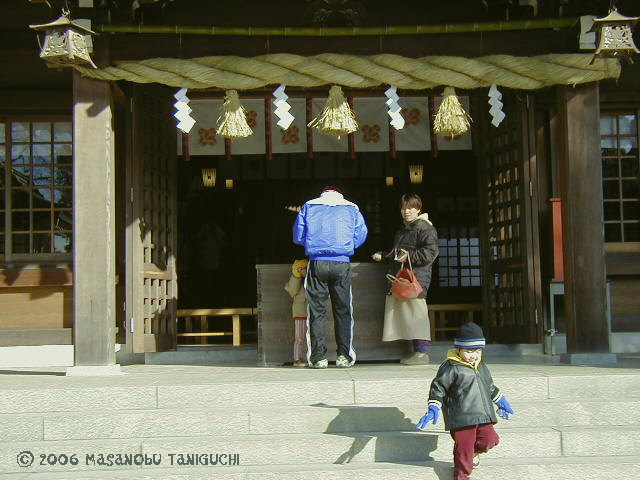
A little boy is wandering away from the shrine before his parents and sister have had a chance to finish praying. My mother tells me that I was a restless kid, too. I might have had a short attention span, but it also might be that I, like the little boy in the photo, was paying attention to something other than what he was expected to. Just as this watchful mother pays extra attention to him, my mother may have made extra efforts in raising me, something for which I am very grateful.

- MT

Sunday, October 01, 2006

Road from a Shrine (2)


A young couple is walking out of the shrine, probably after praying for their future and happiness. I am reminded of the early years of my marriage or even before that, when I envisioned a bright but somehow uncertain future with my (prospective) wife. Looking back from after 25+ years, I now feel certain and am confident that the sharing of our lives has produced a rich, fruitful experience that we could not have had without marriage. I hope this couple will walk together in that direction.

- MT

Friday, September 15, 2006

Road from a Shrine


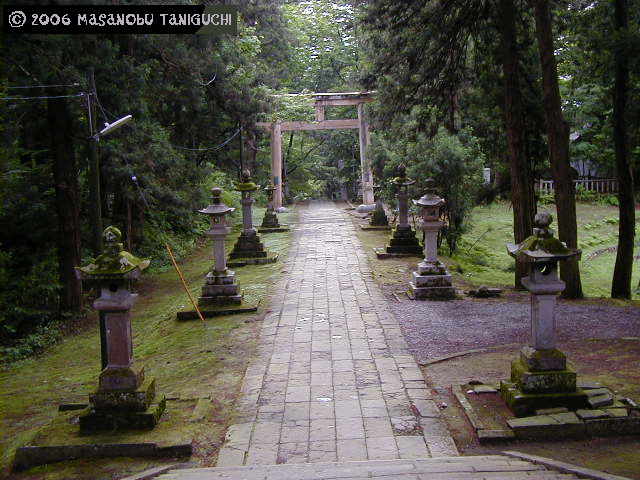
I took this photo immediately after having paid homage at a shrine. Feeling at peacel after praying, the same path I climbed toward the deity a few minutes before looked different. I felt relieved and relaxed and found the scene very congenial to my state of mind. The symmetry of the scene perhaps held the scret of this state of mind.

- MT

Sunday, September 10, 2006

Road to a Shrine


The path leading to a shrine or temple is often made to imply a "difficult path." There may be a long flight of steps or a series of gates to pass, or both. Pilgrims are willing to surmount these obstacles in order to get a sense of being spiritually uplifted. This is sometimes similar to endurance sports such as mountain climbing and long-distance running. It may be that the ultimate objective of the sports and that of the pilgrimage are the same.

- MT

Friday, September 01, 2006

Tree-Lined Road


We love to plant trees along the roads. This is not done necessarily to suggest a destination for pedestrians nor to provide an opportunity for unexpected encounters. I look at it as a way to enjoy distractions. Life can be described in terms of destinations or a series of choices, but it also has plenty of distractions. The gingko leaves are beginning to turn the vibrant yellow of the fall. By this time, the female trees are full of fragrant fruit and sprinkle them on the road. Some people hate the smell and avoid going near the fruit, but other don't hesitate to pick them up from off the road to serve for dinner. In this sense, life consists of many distractions, and we love them.

- MT

Thursday, August 31, 2006

Stepping Stones


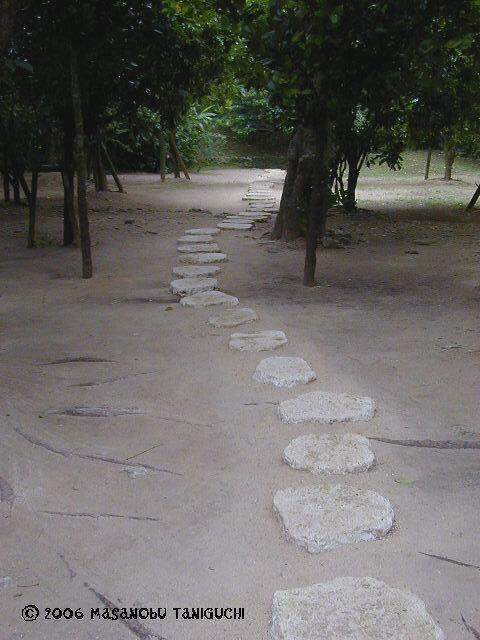
Unlike railway tracks which suggest a predetermined direction, a path of stepping stones may give us the sense of it being a series of choices. It nevertheless leads to a predetermined place as well. In this sense, it may be more like real life, in which we make many decisions, but may sometimes feel we cannot help but lead ourselves to an inevitable place.

- MT

Wednesday, August 30, 2006

Railways


Railway tracks are laid to transport people and things to far-away places, smoothly and quickly. When seen from above, they make clear silver lines that sometimes stimulate our imagination. These lines in the photo stir a sense of destiny in my mind. Two sets of lines merge into one in the distance. It can be likened to marriage or friendship. Another set of lines approach from the left. This may be a sibling or someone from our past. A woman and a dog crossing the tracks can be another relationship we come across in our journey throughout our destiny.

- MT

Wednesday, August 23, 2006

Ticket Booths

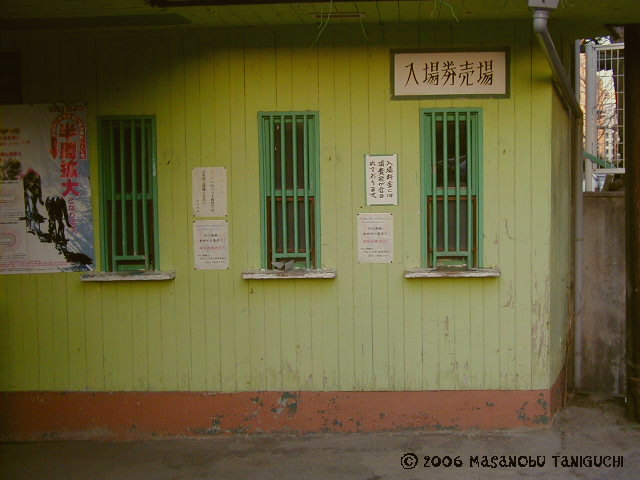
I am not particularly fond of bicycle racing but found the color combination of these booths impressive. The Japanese usually do not paint buildings in bright colors such as yellow, red and green. This building is therefore an exception. And, when I look at the scratches and cracks on the wall, I can almost see those who win and lose at the race and hear them screaming and grumbling.
- MT

Tuesday, August 22, 2006

Osaka Night


Osaka is the third largest city in Japan in terms of population. Being a Tokyoite, I am not very familar with the city even though I have visited it for short stays several times in the past. This photo was taken from a high-rise hotel and probably reflects one feature of the city: highways and buildings spread to the furthermost edge. Night effectively conceals the chaotic intricacy of the cityscape with the lights giving it a sense of composition.

- MT

Monday, August 21, 2006

A Remote Mountain (3)


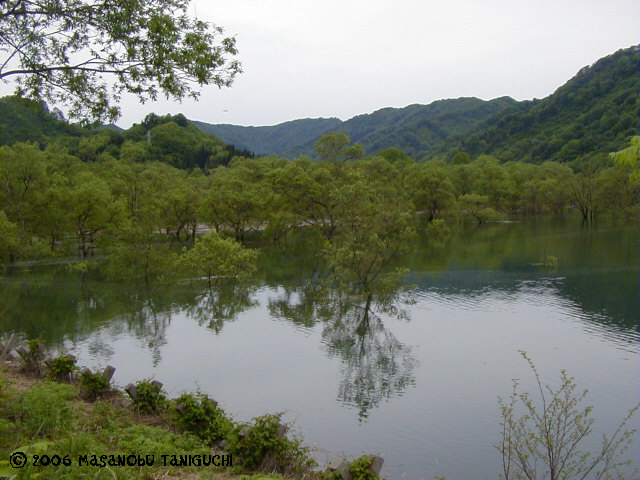
When I went to the mountain in the Spring, I was impressed with the serenity of Lake Yakuwa, where trees, half-submerged in the waters, survive and are even thriving, 45 years after the construction of Yakuwa Dam. In the novel I wrote, the newspaper reporter scuba-dives in the lake to find a way to get to the old deserted village about which he heard from a retiring police officer.

- MT

Sunday, August 20, 2006

A Remote Mountain (2)


The idea of the story was inspired by the movie "Nell"(1994) in which a small-town Southern doctor discovers a woman who's been raised completely apart from civilization. I changed the situation a bit by moving the locale to a Japanese moutain in which a newspaper reporter discovers a 15 year-old girl. Her parents became isolated from civilization when they refused to move from their mountain home when water from a dam constructed nearby flooded the area around their house.

I'd rather not reveal the whole story. This photo shows one of a few dams located near Tsuruoka, where the main part of the story develops.

- MT

Friday, August 18, 2006

Remote Mountains


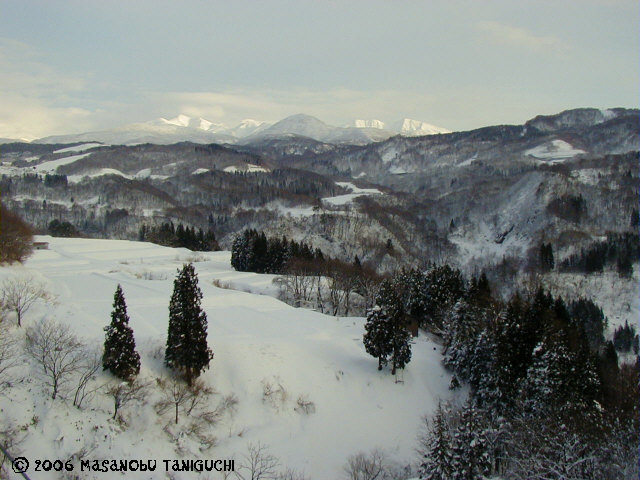
The photo was taken a couple of years ago when I went to Tsuruoka, Yamagata Prefecture, in order to begin writing a novel I entitled "Hikyo" (A Remote Mountain). The story is about a girl living alone in a remote mountain region, completely secluded from modern civilization. Of course, no such place exists in present-day Japan. However, this scene fit my idea perfectly. I recently started a painting based on this photo for the forthcoming book.

- MT

Wednesday, August 16, 2006

Lobster Cook


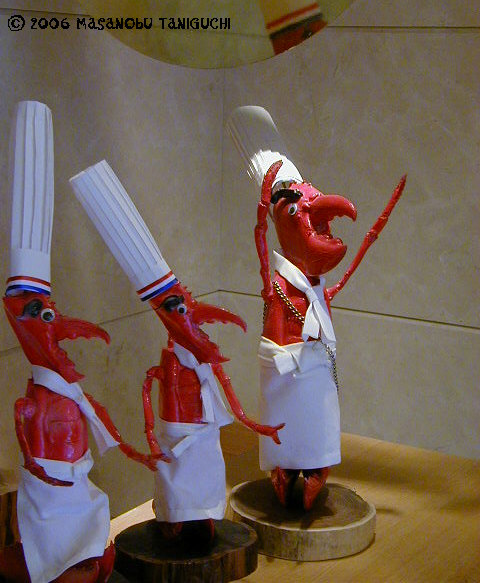
These lobster dolls may tell us a few things. Firstly, we can eat them because they are ridiculous. Secondly, we can punish them because they act like humans. Thirdly, they should be resurrected as cooks because they deserve compensation. The cooked become cooks by association, or by guilt?

- MT

Monday, August 14, 2006

A Mad Cow


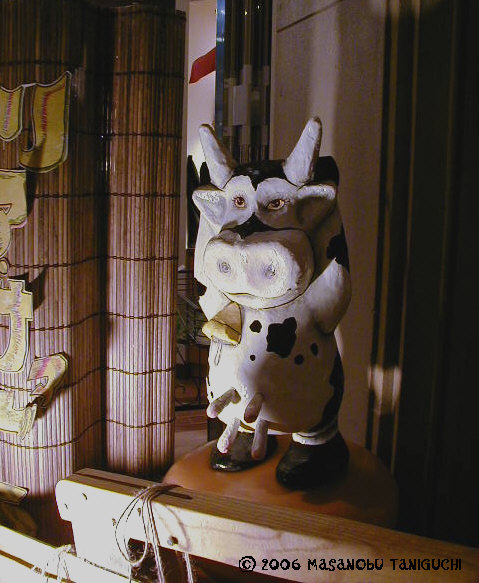
Often times, restaurant owners like to caricature the animal featured in his/her business. By poking fun at it, they may feel that it helps us eat the animal meat without feeling very guilty. This rather serious-looking cow, however, led me to speculate that there may have been other reasons for the shop owner to display this figure.

- MT

Tuesday, August 08, 2006

Rainy Shrine


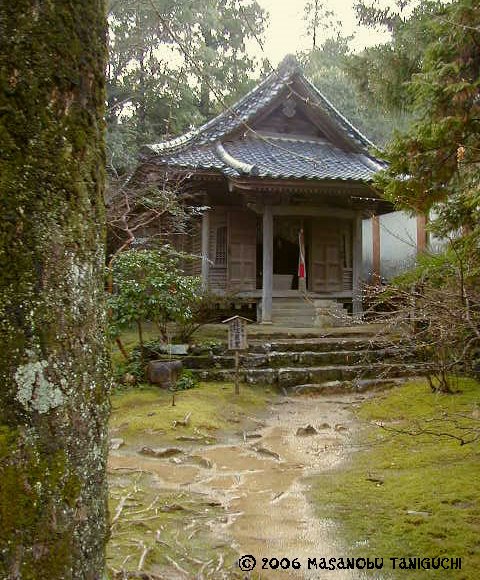
It was raining when I came across this modest and unassuming shrine. It looked very natural with the greens of the moss and leaves. It may be that the rain combined with and enlivened all the components of the scene.

- MT

Monday, August 07, 2006

Symmetry


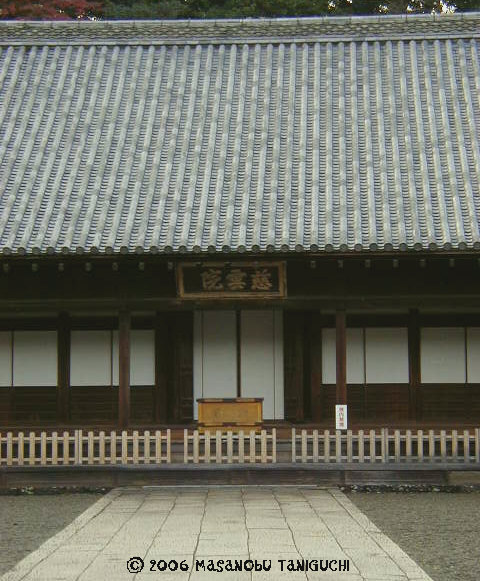
Symmetry has long been used to attract our attention. This Buddhist temple was not an exception. I was impressed with the numerous vertical lines of the roof, which contrast with the simplicity of the doors and windows.

- MT

Sunday, August 06, 2006

The Road Midway


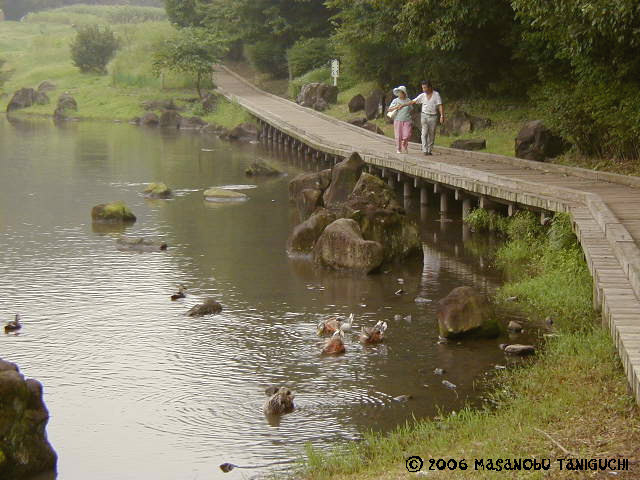
A husband and his wife, probably with a baby in her womb, are walking on a wooden bridge in a park. They may have had a long conversation on the way. The husband is pointing to a discovery he made midway through their walk... Well, scenes like this spark the imagination.

- MT

Saturday, August 05, 2006

After the Rain?


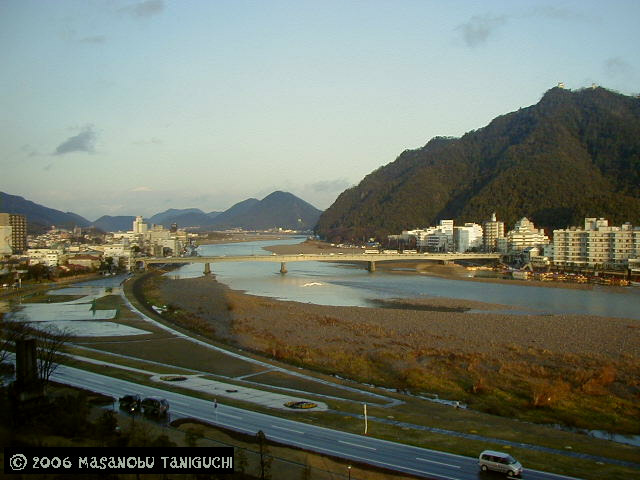
The Nagara River is famous for an annual show of birds called uh catching sweetfish in the water. When I arrived at a hotel by the river in the late afternoon, the sunlight was shining and highlighting the bridge under a clear sky. I noticed that the road and the riverbank were completely wet but could not be sure how or why.

- MT

Friday, August 04, 2006

Temple


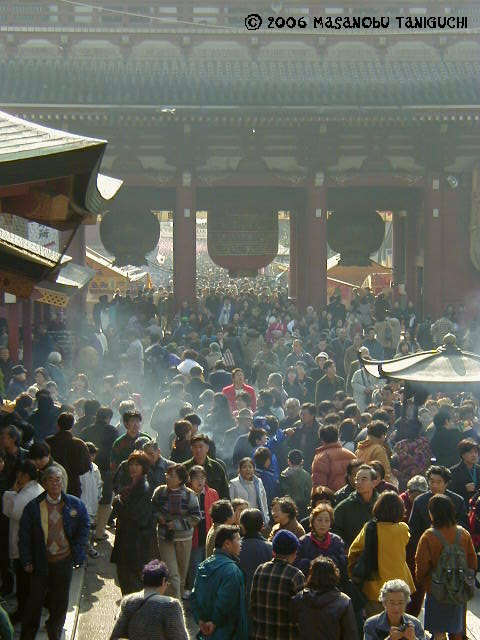
Sensoji temple in Tokyo is filled with people colebrating the New Year. This event, as well as many similar events taking place at thousands of other temples and shrines in Japan is evidence that the Japanese are religious people. Yet, you may be surprised to know that the majority will say, when asked individually, that they don't believe in any particular religion. The phenomenon has been dealt with in several books in Japan, but without any satisfactory explanation.

- MT

Thursday, August 03, 2006

Clones or What?


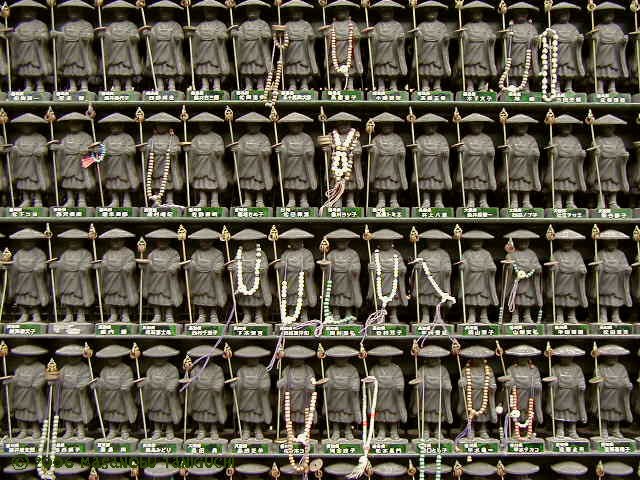
If you want to talk about cloning humans, this image may have some relevance. Or, does it? I took this photo at a Buddhist temple dedicated to Kukai, a Japanese monk who founded the Shingon sect of Buddhism in Japan. These clone-like figures are his miniatures, about two-inches tall. Visitors to the templer buy one of these figures and display it as a symbol of his/her devotion to and faith in the monk. You may notice the white characters inscribed at the bottom of each figure. These are the names of the people who dedicated each. These figures, en masse, demonstrate the wide and intense popularity of Kobodaishi, another name for the monk.

- MT

Wednesday, August 02, 2006

Billboard


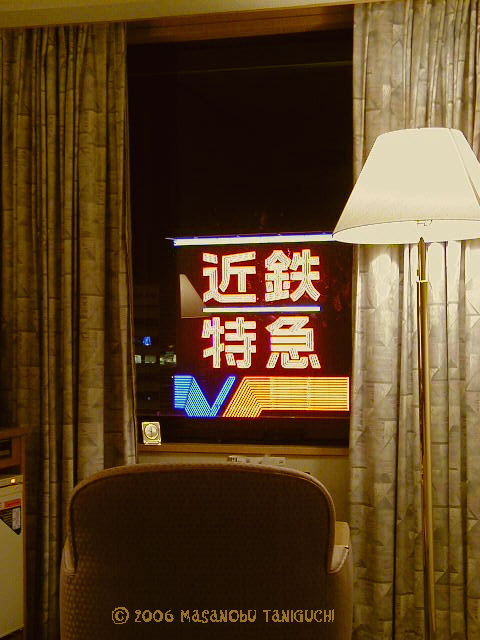
A billboard in the scene from a window is often an annoyance when you are in a hotel room. This electric billboard, however, was so big and bright at night that I could not help noticing the beauty in the combination of colors and darkness that was cut out by the window frame.

- MT

Tuesday, August 01, 2006

Spotlight


Hotel rooms have various atmospheres -- humble, gorgeous, pretentious, clean, dusty, dry, wet, warm, and cold. The first impression I get after entering a room usually lasts until I leave the room the next morning. My wife's impression sometimes differs from mine. This may be due to the ways we see things in the room. I tend to look at items like paintings, wall paper/cloth, TV set, soap, and shampoo. When I entered this dimly lit room, the small spotlight above the side table was illuminating the glasses and tea cups. They looked so clean and attractive.

- MT

Monday, July 31, 2006

Two Heads


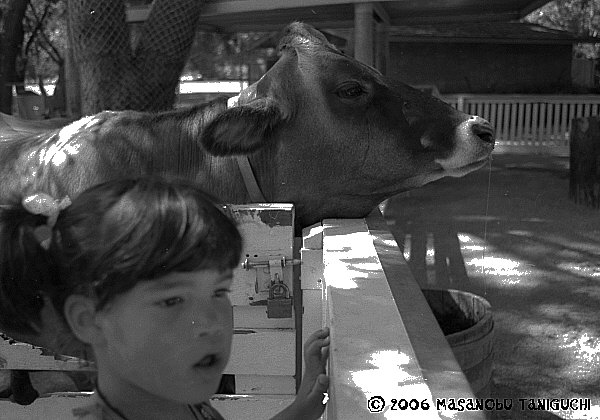
These two species of animals have two very different heads. Yet, they share many commonalities: two eyes, two ears, two nostrils, hair, and a mouth. Indeed, the appearance betrays internal commonalities. DNA sequences shared by humans and cows are vast. They can communicate with each other. They even share diseases: "Mad Cow" disease can spread among humans, for example. When we look at the differences, we feel it's acceptable to torture, kill, and consume the animal. But when we remind ourselves of the similarities, we can reduce the death toll.

- MT

Sunday, July 30, 2006

Animal


A cat is an animal because it is animated. This simple statement invites many questions when we look at this photos. Is it possible to say that a cat in a photo is not an animal because it is not animated? If the cat is still an animal even in a photo, what about the sandals and boots? Is it appropriate to say that the sandals and boots are also animals when they are animated (by someone's feet)? We may say that they are not animals because they don't have life. But the problem still remains: We cannot measure life. A lotus seed in a stratum thousands of years old may or may not sprout. We cannot predict this in a scientific manner.

- MT

Saturday, July 29, 2006

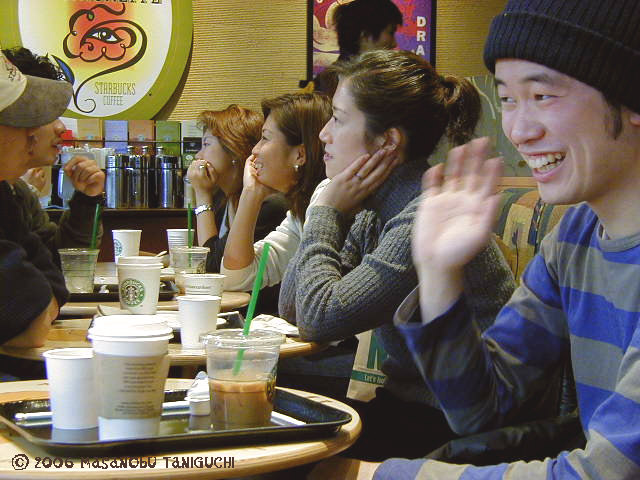
Dating


The essential part of dating is conversation. You may not be able to tell from appearance whether or not a couple is truly enjoying the conversation. But you may be able to see their eagerness to connect.

- MT

Friday, July 28, 2006

Green Tower


A green tower stands out in the dark of Harajuku, one of the most popular districts in Tokyo. I live about one bloc south of the building but seldom go inside because most of the shops in it are for girls. Harajuku once was a quiet and serene residential area, with a tree-lined street dotted with shops and restaurants for older adults. It is now filled with beauty shops, boutiques, and restaurants for young adults. This building represents the new trend, in which I feel increasingly uncomfortable. But the night showed it differently.

- MT

Thursday, July 27, 2006

Night Tower


The night in Tokyo creates unexpected sights at unexpected times. The 1100-feet-high Tokyo Tower is the tallest landmark in the city but not the brightest since it does not have as many internal lights as an ordinary skyscraper. But, when seen from a direction, with no other buildings in sight, it does look the brightest, and even dangerous.

- MT

Wednesday, July 26, 2006

Tunnel


Once every week or two, I travel throughout Japan on business. I generally take a flight that leaves Tokyo at around noon on Saturday and get back at night the next day. On the way from Tokyo International Airport (Haneda) to Shibuya where I live, there are several long tunnels. This photo was taken on one of my trips back home when I felt very free and relieved after my trip.

- MT

Tuesday, July 25, 2006

Dolls at the Grave


If you are Japanese, the immediate interpretation of something like this would be that there were a number of unborn children, aborted or miscarried, who do not have a final resting place. Japanese women remember these children in this way by putting dolls in front of a diety. The words engraved in the tallest stone read, "Please bless all souls in the three worlds." I don't know why all the dolls are girls, though.

- MT

Monday, July 24, 2006

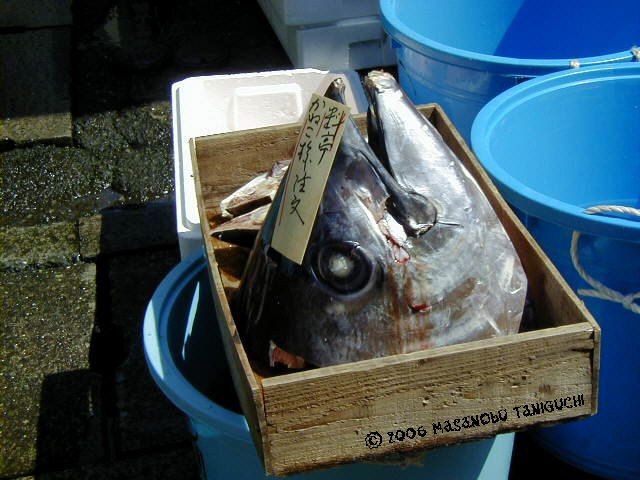
Fish Head


Fish heads are a delicacy in Japan, especially when they are from large fish such as blue-fin tuna and bonito. I found this head at a fish market in Misaki, Kanagawa prefecture. There is a wooden tag attached to the nose of the fish reading "Reserved for the restaurant Kaneko." Cartilage, cheek, and even eye balls are served for the Japanese dish "kamayaki."

- MT

Sunday, July 23, 2006

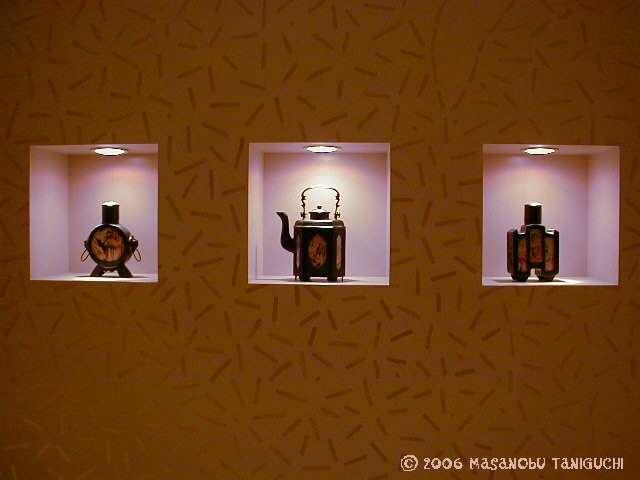
Three Pots


These pots displayed in the shade of a Tokyo restaurant caught my eye. They looked like three proud persons neatly dressed.

- MT

Saturday, July 22, 2006

An Accident

Surfing through the Internet, I recently came across a photo of an Japanese old man closely resembling my father. Actually, I thought at first he was my father. But he couldn't be my father because my father has been ill in bed for more than a year. I asked the photographer when and where he took the picture. The answer: recently in Shibuya, Tokyo. My father lives in Shibuya, next to my house. I showed the photo to my father, and he denied the photo was him.

This is an example of an accident, an unintentional happening. Or, it can be called coincidence, a simultaneous agreement without human intervention. But I doubt this happened truly without human intention or intervention. Given the global population, it is conceivable that anyone's appearance resembles someone other than himself/herself. But the probability that they would meet face to face, unless they are identical twins, is very slim. Does the emergence of the Internet, where time and space are minimized, make this probability greater? I think so. But the meeting of any two persons on the Internet, even for the first time, is not an accident or coincidence because it necessitates a series of intentional selections on the part of both parties.

- MT

Friday, July 21, 2006

Colongne Box (from my archives)


I don't know if there are still any more of these dispensers in the United States, but I found it 30 years ago in a restroom in Placervill, CA. I am not sure if it was a box for colonge or soap. It looked shining and clean, so I shot this photo. The boy is a grandson of my English teacher.

- MT

Thursday, July 20, 2006

A Running Girl (from my archives)


Being independent by nature, a cat normally does not want to be dragged along with a leash. This kitten, howerver, seems happy to run with its neck bound probably because it likes the companion. The girl was the granddaughter of my English teacher. The girl was born and raised in Japan and looked very nice in kimono. She even has a Japanese name. I wonder how she looks now after 30 years.

- MT

Wednesday, July 19, 2006

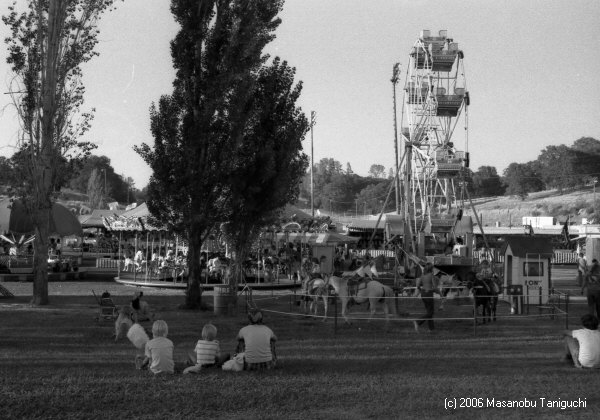
County Fair (from my archives)

This is a good old-fashioned county fair, where people enjoy ridings, selling and buying things they produced and crafted. I was born and raised in Tokyo. Attending this type of community event, at that time (30 years ago), was totally a new experience to me. I enjoyed the day with my host family.


- MT

Tuesday, July 18, 2006

The Goat and A Car (from my archives)

A goat looks at a car in the shade. The engine of the car is probably off because the goat would hesitate to come so close if the engine were running. The goat may be curious about the car, for the car may have been driven by a visitor. Who is the visitor? I am not sure, but it may have been myself.

This picture was taken about 30 years ago when I visited an American family in Placerville, California. They were my English teacher (when in Japan), her husband, daughter, son, this goat, horse, cat, and dog.

- MT

Sunday, July 16, 2006

Flowers

I am on a plane flying from Asahikawa, Hokkaido, back to Tokyo. My wife and I attended the Seicho-No-Ie Public Lecture meeting held in Asahikawa. Although it was too warm and humid in Tokyo, the people in Hokkaido, the northernmost island of Japan, are now enjoying the best season in the year. It is dry and cool with many different blowers blooming.. The leaves of the trees are bright in the sunshine, and the cherry trees are heavy with their red delicious fruit.

After the lecture meeting, we went to a flower park in Bibai, located on the outskirts of Asahikawa City. the park was literally covered with flowers of so many different colors--sunflowers, lavender, petunias, begonias, digitalis, lupines, marigolds, lilies, and California poppies. We walked slowly by the blanket of flowers, praising their beauty as we took photos here and there. There were many other people doing the same. I realized that they were truly enjoying the sights and we were, too.

As I wrote in my July 12th entry, we are "visual animals." All the colorful stimuli entering my eyes made me feel truly relaxed and happy. It was especially revealing that this took place even after the six hours of work at the meeting. The lecture meeting started at 10:00 am and lasted until 3:00 pm with an hour taken for lunch. I gave two one-hour lectures for this meeting and conducted a short meditation session as well. Afterwards, my wife and I attended a one-hour meeting with the local SNI leaders. by the time the meeting with these leaders was over, I felt exhausted. But I recharged myself with a glass of cold water then proceeded to the gate of the lecture hall where dozens of people were waiting to shake hands with us. I would say that flowers are man's dearest friends, just as dogs are our oldest. They lift us up and make us feel gentle and loving with their colors, shapes and fragrance.

- MT

Saturday, July 15, 2006

If Mice Have Empathy...

Science magzine recently reported that mice may have empathy toward other mice(Science vol. 312, 30 June 2006). This shocked me because I just got the renewed impression that humans have little empahy toward other animals, especially those raised for consumption. Empathy has often been thought to be a uniquely human attribute. It has been argued that in order to experience empathy we humans developed story-telling, operas, sports, novels, movies, and many other cultural events. When the German soccer captain butted an Italian player in front of TV cameras, many, if not most, felt empahy toward the former, thinking that he had been badly insulted, so badly that no one could blame him for ruining his last match as professional soccer player.

But if mice too have capacity for empathy, a whole different picture would emerge. A laboratory mouse may feel pain when seeing other mise being subject to unpleasant treatment. Since there is no reason to believe mice have more empathy than pigs, a pig, too, may feel intense fear seeing other pigs butchered. Then, what about a cow hearing other cows screaming in a slaughterhouse reeking with blood? I would therefore suggest that we should treat our fellow animals more "humanely." I'm not only talking about dogs and cats but also about cows and pigs.

- MT

Thursday, July 13, 2006

Macrobiotics

I am back home from our mountain villa, lying in bed, typing on the keyboard of my laptop. A soft breeze coming from the electric fan makes me relaxed. It has become cooler, but I was shocked by the heat in Tokyo about four hours ago when I came out of my car to have dinner with my daughter and wife. It was humid and around 30 degrees celsius, or 86 degrees Fahrenheit. We all agreed that we missed the cooler temperature and drier atmosphere at the villa.

During the dinner my 21-year-old daughter raised a question on Macrobiotics. Skimming throughthe two books on this subject which my wife bought during our stay in Ohizumi, my daughter seemed to be interested in this dietary lifestyle. She asked if my wife and I, already semi-vegetarians, were going to quit all meat including chicken. My wife answered, "No. At least not now, though we may be gradually reducing chicken meat."

Macrobiotics recommends that we base our diet primarily on foods native to the climate and environment in which we live. That is because our body is genetically adapted and, therefore, most fit to our environment. The basic idea is to eat food that is locally produced. Macrobiotics also asserts that our teeth represent the ideal proportion of foods in the human diet. That is, it recommends that we eat less meat and more grains and vegetables because most of our teeth are designed to crush or grind grains, beans, seeds, and other tough plant fibers and to cut vegetables. According to them, the ideal proportion of human foods is five parts grain and other tough fibrous foods, two parts vegetables, and one part animal food.

About a week ago my wife and I attended a Seicho-No-Ie Special Conference, where many problems in meat-eating were discussed. There are basically three areas of concern: 1) ethical and religious issues, 2) health issues, 3) environmental issues. My wife seemed so impressed with the seriousness of the problem in meat-eating that she wanted to pass some of the information she got there to our daughter.

- MT

Wednesday, July 12, 2006

Mowing the Lawn

It took some time for me to notice that my wife was up and working outside. I was in my futon bed trying to go back to sleep, thinking that I had not had enough sleep, when I heard the knocking-like sound near the front door of the villa. The sound, rather hollow and not repetitive, was not exactly like knocking. I assumed therefore that my wife was taking something out of the storage by the front door and made the sound when she shut the door of the storage room. I went back to sleep afterward.

I woke up from a short dream, noticing that she was sitting by the kitchen table. I asked her about the time and she told me that it was around seven-thirty. I decided to get up. She told me that she couldn't wait pulling out weeds and cutting the overgrown lawn until I got up. I asked her when she got up."Well, I think it was around five thirty," she said. I was impressed with her vitality.

After having breakfast I went out to see what my wife had done. It was a mess, not because she had done anything wrong but because she could not catch up with the wilderness nature had produced during the two months of our absence. I started to gather drawn-out weeds and cut grasses and, then, involved myself in mowing the lawn. It was only after my wife came out and told me what time it was that I, drenched with sweat and mud, decided that I should stop the work no matter how unsatisfactory it looked. Two hours passed like a half an hour.

It is sometimes said that humans are "visual animals." This is because we are preoccupied with the information obtained through our visual system. Visual arts, tourism, gymnastics, sports, racing, scuba diving, sky diving, space flight, and even eating cannot be fully enjoyed without seeing. Gardening may be one of those human endeavors born out of this preoccupation. No matter how strongly we are attracted by nature, we seldom give up modifying nature when nature looks truly natural.

- MT

Escape from Humidity

It has become humid and warm in Tokyo these days. The tropical storm that hit China and Korea recently has brought even more humidity and heat over Japan. It is this humidity that makes living in Tokyo unconfortable and even miserable in Summer. This is why I decided Today to go to our mountain villa with my wife.

It's been more than two months since we were there the last time. It was in May, and we still could see cherry blossoms in the mountains. There were even snowcaps on the mountain tops above 2,000 meters. I took several Spring shoots from Taranoki (Aralia elata) and enjoyed tempura using them.

This time our 22-year-old daughter decided to join us. Three of us had dinner together at an Italian restaurant near Meiji Park and left Tokyo for Ohizumi, Yamanashi prefecture, where our villa is located. We were all jubilant. My wife had just finished her one-hour lecture at a meeting, my daughter after her work, and I after submitting my manuscript for a monthly magazine. We all needed some good rest.

- MT

Tuesday, July 11, 2006

Can't Help Saying This

I've decided to enter this club of bloggers so that I could say something to my English audience. I wanted to say that my Japanese blog has been experiencing a problem for a while, probably about 3 days. I had difficulty in entering and registering blog entries, and the system administrators, whoever they are, were not responding at all. So, I decided to go "overseas" and complain. This may not sound like a good reason to blog. But I cannot help it.

Thank you for your taking the time to read this.

- MT

Wednesday, September 11, 2002

Cancellation of this Series

I believe there may have been some readers who've been concerned about the interruption or break between my journal entries. Due to many factors, I've decided to suspend this series for now. I'd like to thank all you readers for allowing me to ramble on about everything--from new scientific technology and issues dealing with the environment, personal miscellaneous writings, things that happened at home, eating habits, to puns--during this past year and a half. The feedback that I received from you was what helped me continue this for as long as I have. It was the biggest source of encouragement for me. The entries in this series became two books, Shokan Zakkan Part 1 and Shokan Zakkan Part 2, so it was by no means a waste.

It's not that the feedback from readers has stopped. The biggest reason for my deciding to suspend this section is that because I can no longer continue to provide both articles and drawings for the entries. And I've also come up with something else I'd like to do. Those who have their own website can, I'm sure, understand, but it takes a lot of time and energy to maintain a site. If one begrudges this, it soon becomes "old" and "covered with cobwebs"--a "haunted house" that no one will want to visit. So, before that happens, it's probably best to announce that "This house is closed."

I am going to suspend with the regular entries to this site, but, when I have something to say, I intend to write elsewhere in another section. Although I don't have too many occasions to draw any more, I will probably share new drawings with you on another page, too.

It's been a year since the terrorist attacks on the United States. It's wonderful that we were able to observe the "First Anniversary" of that event without a repetition of what happened then. However, without having confirmed or captured the person or persons responsible for this horrendous crime, President Bush has clearly defined his plans to attack a "new enemy" and is seeking people to endorse this. On the other hand, it also seems that the United States is refusing to deal seriously with global warming. War is the most direct way of destroying nature, and, at the same time, destroys the minds and physical bodies of all people involved as well. When we think of it in these terms, I would really like the leaders of all nations to assist and ensure that humankind does not go in this direction of "destruction."

Shouldn't we who believe in God try to believe even more completely and totally in Him? We cannot believe in a "God" who loves a particular group of people, and hates, curses, and murders others. That is simply trying to justify belief in a "deluded self" in the name of God. If God, omnipotent and omniscient, creates "enemies" and "evil", or allows for "enemies" and "evil", then there is no way that we humans, who are neither omnipotent nor omniscient, can win against the "enemy" or destroy "evil." In other words, there will be no peace on this earth with that kind of belief or religion. So, it's up to us--we must go beyond belief in that kind of prejudiced and biased God, and spread the belief that "God does not create evil" throughout the entire world.

- MT

Wednesday, August 21, 2002

A Blessed Classroom

In the "Voices" column of today's Asahi Shimbun newspaper, there was a letter to the editor from a 65 year old high school teacher asking that "air conditioners be installed in classrooms during the summer." According to her, "In a classroom where the temperature goes over 35 degrees (Centigrade), you perspire profusely and the perspiration literally gets into your eyes and runs down your cheek." The reason students and teachers subject themselves to this heat and go to school is that, since the 5-day school week was fully implemented, there aren't enough hours in the school year to finish the curriculum. Reading this, I was filled with mixed emotions.

That is to say, my three children have never had to go to summer school to catch up. It's not that their grades were particularly good, but, since they went to a high school that is "attached" to a university, there was no real need "to study for entrance exams." This, and the fact that the classrooms in my children's school were all air conditioned so that my daughter even says that "the air conditioner is on too high" and takes a sweater to school in the summer--all the facts came up which contrasted sharply with the situation in the letter.

High school textbooks nowadays clearly explain global warming and the need to preserve the environment, and there are undoubtedly questions on these subjects on the student exams. One of the main reasons for global warming is the excessive use of energy by the developed countries--This is surely something they must know. But, it's as if "knowing" and "doing" are completely separated. The relationship between what is learned at school and their actual lives is very weak. I've always suspected that to be the reason why teachers don't think a thing about turning up the air conditioning so high that one actually feels cold. I've found out, albeit a little belatedly, however, that this problem does not exist in public schools.

So we can say that the school that my children attended is very blessed. It's not easy, though, to determine whether or not being blessed materialistically like this is actually "a good thing" for children who are in the process of growing up and becoming adults. When I was in high school, we had heaters in our classrooms, but not air conditioning. Even so, I don't remember it being "too hot to study" during the summer session. And, since we didn't have convenience stores, fast food restaurants, or vending machines, we couldn't buy things, and we had almost no way of buying alcohol or cigarettes. We didn't get very much of an allowance, and we didn't have cell phones, so, naturally, there weren't any problems associated with them, including Internet date sites accessible with cell phones. In other words, while we may make a "society that is blessed with many things", at the same time, we create "complex problems" as well.

I touched earlier upon the fact that my children didn't have to take "entrance exams," but I wonder if this really is a "blessing." In the current economic environment, one can't get a job in a good company simply by having "graduated from a famous university." It's not enough for the university to be "famous", but, unless one is a graduate of Tokyo University, Waseda University or Keio University, it's difficult to get the job of your choice. Even if one's grades are high, it doesn't mean that you can get a job related to your major. So, we might say that they "aren't blessed." But, it also may be that using the time usually spent to instead play a sport, spend time with friends, or read develops a broader personality. That way, it may be that, when one becomes an adult, even if you're not guaranteed a spot on the road of the elite, one can choose a way of living that doesn't separate "what you know" from "what you do." As parents, that's what we hope for, but in the end, it's all up to the individual, so it's not easy to say what exactly it is that determines "how blessed" we are.

- MT

Sunday, August 18, 2002

Faith and Preservation of the Environment

The global climate is undergoing an unusual change. Those who have been watching the recent weather-related news undoubtedly must think so. Both the Asahi Shimbun and the Sankei Shimbun took up this problem in today's issues. Not only the tremendous flooding in Europe, but in China and Southeast Asia as well, there have been large-scale water-related disasters. On the other hand, warm sunny weather has continued in North America, and there are concerns about an increase in damage done by forest fires. It's only natural to think that, as with the environmental situation in Germany, damage from global warming is becoming increasingly more serious.

I spoke on global environmental issues at the Seicho-No-Ie National Conventions in May, and emphasized the fact that, unless we spread the teaching that all living things on this earth are "one in God" to more people, the situation will only grow to become even more serious, and we will not be able to get to the root of the problem. As one can see, however, the state of the world is such that there is no end to people looking at their peers in "humankind" and the need to destroy those they consider "axis of evil" much less look at "all living things on this earth" as being friends. This holds true not only for the United States. The Arabs and Israelis, those in India and Pakistan whose countries have a long history of conflict, pour their energy and intellect in war and military buildup and turn away from issues regarding the environment. There are other countries, too, where the people cry out that the economic and military power of their neighbors are "threats". There may, indeed, be that type of "threat", but, isn't the fact that the way humankind lives--particularly those of us in developed countries--is creating a "threat" to humankind a much more serious problem?

I received advice from someone recently saying that religion should not get involved with environmental issues, but should instead concern itself with how to explain and teach subjects originally associated with religion, that is "God" and "faith." This person says that people can use their own common sense about things pertaining to the environment, and they aren't something with which religions need bother. I don't understand this kind of thinking. If what something someone strongly believes in is "faith", then what that person believes will definitely be expressed within that person's life. "Believing but not doing anything about it" isn't believing, but only "knowing." It's not that those who believe that "God is love" don't love their children, parents and friends because they feel God does everything, but, according to the will of God, they "practice" giving love, not only to their family and friends, but to strangers as well.

For those of us living in developed countries, I believe that there is a need to recognize the fact that environmental issues have to do with our lifestyles and the wasteful way we use energy, and then look for ways to "practice" changes in our lifestyle to decrease the number of people who are, as a result, victims of this wasting. Those who know that their lifestyle gives way to victims in developing countries and don't do anything about it may "know" God who is love, but they cannot say that they "believe" in Him. That's why, those who believe should pay attention to even the most trivial of things and try to figure out what in their lives they can adjust to decrease the amount of energy wasted. Since people who don't believe in God are trying to do so recently, there is no reason why believers shouldn't.

Based on this, Seicho-No-Ie International Headquarters and its Main Temple in Japan acquired "ISO14001" certification, also called "Environmental ISO", in the summer of last year, the first in Japan's religious corporations to do so. Receiving this certification, however, is just the beginning. There are cases in which certification is revoked if the organization does not meet the very strict international criteria in annual judging and inspection. Since the beginning of this year, Seicho-No-Ie's different Missionary Areas throughout Japan have acquired this certification as well. It's impossible to continue this type of subtle, consistent effort on a whim. It becomes something with permanence only when a "reform of consciousness" occurs at the individual level. That is why a movement to preserve the environment based on faith is being sought now.

Of course, this should happen, not only at the corporate level, but we should try to change our own individual lifestyles as much as we possibly can. It's a bit embarrassing to talk about myself, but it's been four years since I installed a solar power generator on my house. And, in order to save forests from being destroyed to raise farm animals, it's been about 4-5 years since I've stopped eating beef and pork. My wife wrote somewhere about our using a rusty old oven toaster, and it's been about 15-16 years since we bought our rice cooker. Our washing machine, which we've repaired twice, goes back even further. We didn't turn on the air conditioning at home at all this year, and I only used the one in my office once. None of this would be possible without the cooperation and understanding of my wife and children.

I don't pretend to think that global warming will stop with this, but, if this kind of change in thinking occurs with more people, and that is reflected in our daily attitude and consumer actions, then it will definitely lead to a tremendous difference. Without this type of change at the "grassroots level", I don't think there will be a solution to the problems concerning the environment. What do you readers think?

- MT

Friday, August 16, 2002

Outside Market Value

In an entry made earlier this year, when I wrote about lavender sticks, I criticized the determining of economic statistics in the following way, "The mere fact that lavender grows is, in and of itself, a blessing. We should be grateful, not only to our fellow man, but also to insects and to the earth. If people living in the city derive more pleasure out of the decorations and ornaments created by manufacturing it (lavender) than going to the movies, the fact that this value is not reflected in business statistics means that there is something very wrong with our present-day economics." I'm expressing my dissatisfaction that the places where lavender grows do not include the personal ornaments and household items that are made in their economic statistics. In the course of explaining this, I went a little too far when I said, "There's something wrong with (the field of) economics today."

I've heard that, in the field of economics, they are currently trying very hard to give ecosystems a numeric value. For example, in the August 9th edition of Science, Robert Costanza, a professor of ecological economics at the University of Vermont, and his team revealed the results of their study on how converting the habitat of plants and animals into agricultural and commercial land not only destroys the environment, but also ends up being a financial loss. This is apparently the result of researching 300 development projects throughout the world.

This team calculated the dollar value of various benefits that the abundant natural environment gives us such as climate regulation, soil formation, nutrient cycling, and the harvest of wild species for food, fuel, fibers, and pharmaceuticals and called it "ecosystem services." They then compared this to the value of the crops harvested from the farmland and/or the lumber from the trees cut down from the forest. In so doing, the difference in cost of preserving large tracts of wild nature and converting it into farm or commercial land would be an overall benefit of "at least 100:1." In other words, the more development that takes place, the more humankind loses.

In 1997, Dr. Costanza and his team estimated the "annual value" of undeveloped wild lands as "$38 trillion." Based on this humankind suffers an annual "loss" of $250 billion. This figure includes any income generated from the development. We are inclined to look only at things that we can see, and so in past economics this "nearsightedness" led to concentrating, not on natural capital, but only on "market" tendencies. However, Dr. Costanza tells us that "we have found that much of what is important to us is outside market value." We must take better care of these things "outside market value."

"Outside market value" might sound complicated, but, put simply, it means "things money can't buy." For example, making lavender sticks yourself is an experience money cannot buy. You may be able to buy lavender sticks at a store somewhere, but making them with your own hands is something no one else can do. This is a tremendous difference from buying them at a store. In the same vein, there's a big difference between making your own firewood and buying it at a store. The same also applies to making your own lunch and buying it at a convenience store. I think there's a tremendously invaluable difference between "doing yourself" and "buying things."

Somehow or other, we think of these things as being "too much trouble" and paying for something someone else has made. That is throwing away a "very valuable something". Why do we do that? A lot has to do with the "time" involved. However, the time gained is often wasted or else spent on "work" to gain even more time. If we continue to do this, we'll end up just "spinning our wheels", something I'd definitely like to avoid in life.

- MT

Friday, July 19, 2002

The Value of Air Conditioning

There are probably a lot of people who think that "Air conditioning is one thing you can't do without in hot, humid Japan." I'm mostly in agreement with that statement. I have a reason for saying, "mostly" and that's because, at the beginning of the 20th Century, no one in Japan thought so. The reason I'm certain that is so is because, at that time, all people in the world, not only Japanese, were able to live their lives without it. So, to be more precise, the first sentence should read, "For most Japanese today, air conditioning is essential in getting through the hot, humid summers." The high in Tokyo today is 32.7 degrees Centigrade (90.9 degrees Farenheit), 3.5 degrees higher than in years past, and the humidity is at 63%. I turned on the air conditioning in my office for the first time this year.

With global warming becoming increasingly more serious, I generally don't turn on the air conditioning at work, but, instead, use an old electric fan. On days like today, though, when I meet with people for extended periods of time in my office, I like to avoid forcing my own "preferences" on others. Although I've never looked into the difference in energy expenditure between an electric fan and an air conditioner, it's obvious that the latter uses more electricity. Another problem with air conditioning is that it's made so that "in making things cool on the inside, it heats the outside." It seems to me that this is really the ego of people of this day and age. With individual families, businesses, shopping arcades, and even the countless number of cars that are driven through the city all contributing to this, the temperature in the city climbs needlessly higher. In trying to lower the temperature, we are actually increasing it.

Reading this, it might seem that I don't appreciate the value of air conditioning, but that's not necessarily so. It's just that I don't think there's a need to cool the cities of Japan to that extreme. There are department stores and movie theaters so cold that there is an unmistakable waste of energy. This all goes against the demands of environmental preservation. But when one thinks of the use of air conditioning on a global level, this technology has had too big an effect on the lives of people, and changed the economic structure of too many countries to be called "of no value."

This year is the 100th Anniversary since the invention of the first air conditioner. The first air conditioner was an "Apparatus for Treating Air" installed at a printing plant in Brooklyn, New York by Willis Carrier in 1902. This printing plant made lithographs, and the color in these lithographs would fluctuate with the change in temperature and humidity. The need for something to resolve this problem brought about a new invention, and, a century later, has changed the lives and economy of people dramatically. Before air conditioning, people in New York would sleep on their front porches or on stair landings, or even on the grass in Central Park to escape the heat.

The city of Houston, situated in southern Texas in the United States, is known for being the place where NASA is located, but being at 30 degrees latitude, it's extremely hot. This is approximately the same latitude as Amami Ooshima in Japan, Cairo in Egypt, or Delhi in India. Without air conditioning, it's doubtful that the more than 1,600,000 people would be able to live there. And, in Dallas, located in the same state in the U.S., it would probably have been difficult for Texas Instruments, the world's foremost manufacturer of computer chips, to establish itself were it not for air conditioning. When you think of it in those terms, then, with air conditioning, it would be possible to manufacture computer chips in India.

There's no doubt that, with the birth of air conditioning, the manufacturing productivity in the "subtropics" or "tropics" has improved. But, now, as it has spread explosively throughout the world, what should we think of it in terms of being a major factor in global warming? With my brain feeling dizzy from this extreme heat, I don't seem to be able to come up with a good answer.

A movie that details the hot summer nights before air conditioning, is "The Great Gatsby", starring Robert Redford (1974). Set on Long Island in the 1920's, it depicts the flamboyant life of Gatsby who owns a huge mansion there. There's a scene where, gentlemen dressed in white three-piece suits, their faces red with the heat, trying to find a way to pass the time with the woman of their choice. So, even 20 years after its appearance, air conditioning hadn't yet made its way into the homes of even the richest people. Strange when you think about it.

Pondering these things, I went to my mother's house next door, and found a beautiful indigo blue fan there. It made me feel cool and refreshed just looking at it. I realized that, in the days before air conditioning, Japanese people used their visual and aural senses to feel cooler. Goldfish, cotton kimonos, wind chimes, and shishiodoshi (bamboo scaredeer), unlike air conditioning, don't actually lower the temperature, but play on a person's senses in perceiving coolness. It struck me as being a very refined way of doing so.

- MT

Sunday, July 14, 2002

Vegetarianism in the United States

The July 15th issue of the Asia edition of Time magazine ran a special feature on "Vegetarianism," which surprised me somewhat because I'd always thought that there are probably aren't more countries where meat eating is as popular as in the United States. This article showed us that the recent trend in this country is not necessarily so. The title of it was "Should We All Be Vegetarians?"

There were a lot of interesting facts throughout the article: "...for many, meat is an obscene cuisine. It's not just the additives and ailments connected with the consumption of beef, more and more Americans, particularly young Americans, have started engaging in a practice that would once have shocked their parents. They are eating their vegetables. Also their grains and sprouts?" According to a poll of 10,000 adults taken in April of this year, some 10 million Americans today consider themselves to be "practicing vegetarians" and "an additional 20 million have flirted with vegetarianism sometime in their past."

There are a number of reasons why vegetarianism has grown in popularity, and one of those is the return to that statement, "Thou shalt not kill." But, it's not that those in the United States have suddenly become so very religious, but, rather, the influence of movies such as "Babe" and "Chicken Run" where animals are the main characters. According to this article, "Vegetarianism resolves a conscientious person's inner turf war by providing an edible complex of good-deed doing; to go veggie is to be more humane. Give up meat, and save lives!" And the "vanguard" for this seems to be, not adults, but children.

It appears that about 25% of teenagers consider vegetarianism to be "cool." In a study conducted by psychology professors at Arizona State University, "salad eaters" were rated more moral and considerate than "steak eaters." A professor at the University of Pennsylvania states, that "Kids today are the first generation to live in a culture where vegetarianism is common and publicly promoted on health and ecological grounds." The interesting part is also that these children don't become vegetarians because their parents taught them, but, in many cases, they decide on their own to become vegetarians. According to the article, "It's often their first act of domestic rebellion?"

I myself don't eat the meat of any mammals, but I do eat seafood, dairy products, eggs, and chicken, so I'm probably not considered a real "vegetarian." Apparently there are many types of vegetarians. Going in order from the most strict, the eight types are: Sproutarianism, fruitarianism, raw foodims, veganism, ovo-vegetarianism, lacto-vegetariansim, ovo-lacto-vegetarianism, pesco-, pollo- and semi-vegetarianism. I would probably belong in the last type. With so many varieties, it's difficult to decide which is best, but Time magazine recommends that, taking all nutrition elements into consideration, any category from lacto-vegetarianism on down is relatively "safe."

I wrote somewhere before that the reason I don't eat the meat of mammals is "to prevent negative effects on the environment." The study by David Pimentel, a Cornell University ecologist supports this: "In terms of caloric content, the grain consumed by American livestock could feed 800 million people...and, if exported, would boost the U.S. trade balance by $80 billion a year. Grain-fed livestock consume 100,000 liters of water for every kilogram of food they produce, compared with 2,000 liters for soybeans. Animal protein also demands tremendous expenditures of fossil-fuel energy...eight times as much as for a comparable amount of plant protein...And the U.S. livestock population consumes five times as much grain as the U.S. human population." And the most extraordinary fact being, "the U.S. livestock population--cattle, chickens, turkeys, lambs, pigs and the rest--outnumber humans 25 to 1."

The accuracy of the numbers quoted at the beginning--10 and 20 million--cannot be guaranteed. That's because, out of the 10,000 people surveyed, 4% of the respondents considered themselves to be vegetarians, and out of that group, 57% considered themselves to be "semi-vegetarians." And 36% of those considering themselves to be vegetarians answered that they were "ovo-lacto-vegetarians." So those who don't eat any eggs, dairy products, seafood, or poultry--the "strict" vegetarians are the remaining 7% (in other words, 0.28% of the population). According to the 2000 U.S. Census, the population of the United States is 281,421,906, so, that makes the estimated number of "strict" vegetarians 790,000. If those are the numbers, then my initial impression wasn't that far off.

- MT

Thursday, July 11, 2002

"Fuji Evening News" and "Shincho Weekly"

News regarding the litigation that I'm involved in was in the July 11th edition of the Fuji Evening News and the July 18th edition of the Shincho Weekly. Having been a newspaper reporter myself, I was saddened to see the very biased and one-sided points of view written quite matter-of-factly. I'd hoped for improvement in the quality of reporting by the media, but, as it turns out, I felt greatly disappointed. Of the two, however, I think that the Fuji Evening News, having included some of my points of view, was relatively "reasonable." On the other hand, the Shinchou Weekly filled their article with opinions of those who've been criticizing me, and only the last 10 lines of the 112 line article were about my opinion.

The "Fuji" article began with the title, "Publication of a Money-Making Book Cancelled--Conditions in the Seicho-No Household," and continues, "The reason for the cancellation of the book had to do with it getting in the way of Seicho-No-Ie propagational policy in the 'Chinese Market' where there are hopes for growth and development. In other words, since the book in question unfavorably attacked the Chinese as though they were a nation of low ethics, continuing publication by the Seicho-No-Ie publisher, Nippon Kyobunsha, on a book like this would adversely effect advancement into the Chinese market" is how it was analyzed. It was so much like a business section article that I was even a little impressed to think that "there ARE people who actually think this way."

Those familiar with the recent Movement Policy of Seicho-No-Ie may not need an explanation, but there are no plans at present for any large scale propagation into China. I believe, however, that the fact that the article points out my opinion that the book in question "slanderously attacks the Chinese people" is commendable. After the lead-in, the article continues on to say, "The reason behind the sudden cancellation of this book is this religious group's desire to propagate in China", but this is not true. The real reason is that the book fundamentally contradicts the Seicho-No-Ie teaching that "Man is a child of God." For example, it claims that some races are morally and ethically inferior to others, implying they are not children of God. We cannot publish a book that contains something like that. From a religious perspective, we must learn from history that recognizing such "evil" in some people and regarding them as "enemies" has led to many religious wars.

There is something important missing in the "Fuji" article. The reason publication of the book in question was cancelled is not only because of the negative comments about the Chinese, but it refers to the political objective of an "independent Taiwan", and, at the time, the author was involved in a serious political confrontation. There are probably many readers who remember a similar situation involving a book, Taiwanron(Talking about Taiwan), by Yoshinori Kobayashi. This comic book clearly supported Taiwan's independence, and in it, the author of the book in question appears and is introduced as being an "advocate of an independent Taiwan." Moreover, the book in question itself is depicted with its actual title, and, in the comic book, the author makes the political statement that "There were no mandatory arrests for wartime prostitutes." The danger, then, is that Nihon Kyobunsha, the publishers of the book in question, and the parent organization, Seicho-No-Ie, might be viewed as supporting the author and his political objectives. So, for Seicho-No-Ie, which in 1983 decided to stop any political activities and concentrate rather on religious activities, the book in question actually became quite problematic.

I'm wondering whether or not to say anything more regarding the article in the Shincho Weekly because, beginning with the title, everything written is so very ridiculous. It says, "'The Leftist Thoughts' by Its Next Religious Founder That Are Shaking Up 'Seicho-No-Ie'." There are no "Religious Founders" in Seicho-No-Ie. Dr. Masaharu Taniguchi writes about that himself in Volume One of the Truth of Life books. The reporter writing the article in the Shincho probably thought that was the only expression that the average reader would understand, but, what about "Leftist Thoughts"? Having used this in the headline, I would've thought that he'd read my books and other writings, and identified that there are "places here and here, so that's why he's leftist", but that's not the case at all. It simply quoted from a "former member" who quit Seicho-No-Ie because he was unhappy with Seicho-No-Ie's withdrawal from political activities.

I'd like you to read the following (the "he" used in the article refers to me):

"Since becoming Vice President in 1988 he has done what he pleases. He was under serious attack by followers who claimed that his statement in the monthly magazine, Riso Sekai (The Ideal World), during the Gulf War, that 'the wars in the Pacific were acts of aggression,' was different than the teachings by the First President.' He then cancelled sales of the nearly 30 'patriotic books', such as We as Japanese and Kojiki and Prophecies in Modern Times, written by the late President Masaharu, that touched on the history of Japan and wars. He has also prohibited publication of manuscripts which have yet to become books.",

This is almost, from beginning to end, simply nonsense, but I did write that "The wars in the Pacific began with Japan's aggressive conduct." I explained this quite extensively, however, in the series in Riso Sekai, in bulletins, and, in the monthly newspaper called Seishimei (Holy Mission) of our organization. Also, the then-Chairman of the Board explained it using quotes from Dr. Masaharu Taniguchi. If these editorials were, indeed, contradictory to the teachings of Seicho-No-Ie, there is no way that the President of Seicho-No-Ie, Rev. Seicho Taniguchi, who is still alive and well, would sit by and say nothing. Moreover, decisions regarding the reprinting of books by Dr. Masaharu Taniguchi are not currently, nor have they ever been in the past, made by the Vice President alone, but, rather, are made by collective decisions. The decisions are based on financial feasibility as well as content. Those who think and say that the sale of "30 books" by the person who started this religious movement with emphasis on propagation through the written word would be cancelled without checking are, in essence, saying that the current President and the entire managerial operations of the organization have been defunct for the past 10+ years (The "former member" more than likely thinks so).

Now, it may not be something that we need to ask readers to keep in mind, but this is generally what articles in Japanese weekly magazines are like. They run some exaggerated headline, and grab the attention of readers with a misleading article. One can only think that they do so just so people will buy them at the newsstands. This is particularly true for groups such as Seicho-No-Ie, where there are many followers who are used to the printed word. They probably think that writing articles that worry and concern the followers leads to an increase in magazine sales. As a former journalist myself, I am deeply disappointed at this sorry state of journalism in Japan, but the imperfection of the phenomenal is not something that's just recently begun. All we can do to rid the dark clouds of the phenomenal world is to continue on brightly and positively with activities that express "the will of God."

- MT